07 / The χ Framework
Thought experiments
The extragalactic vacuum laser
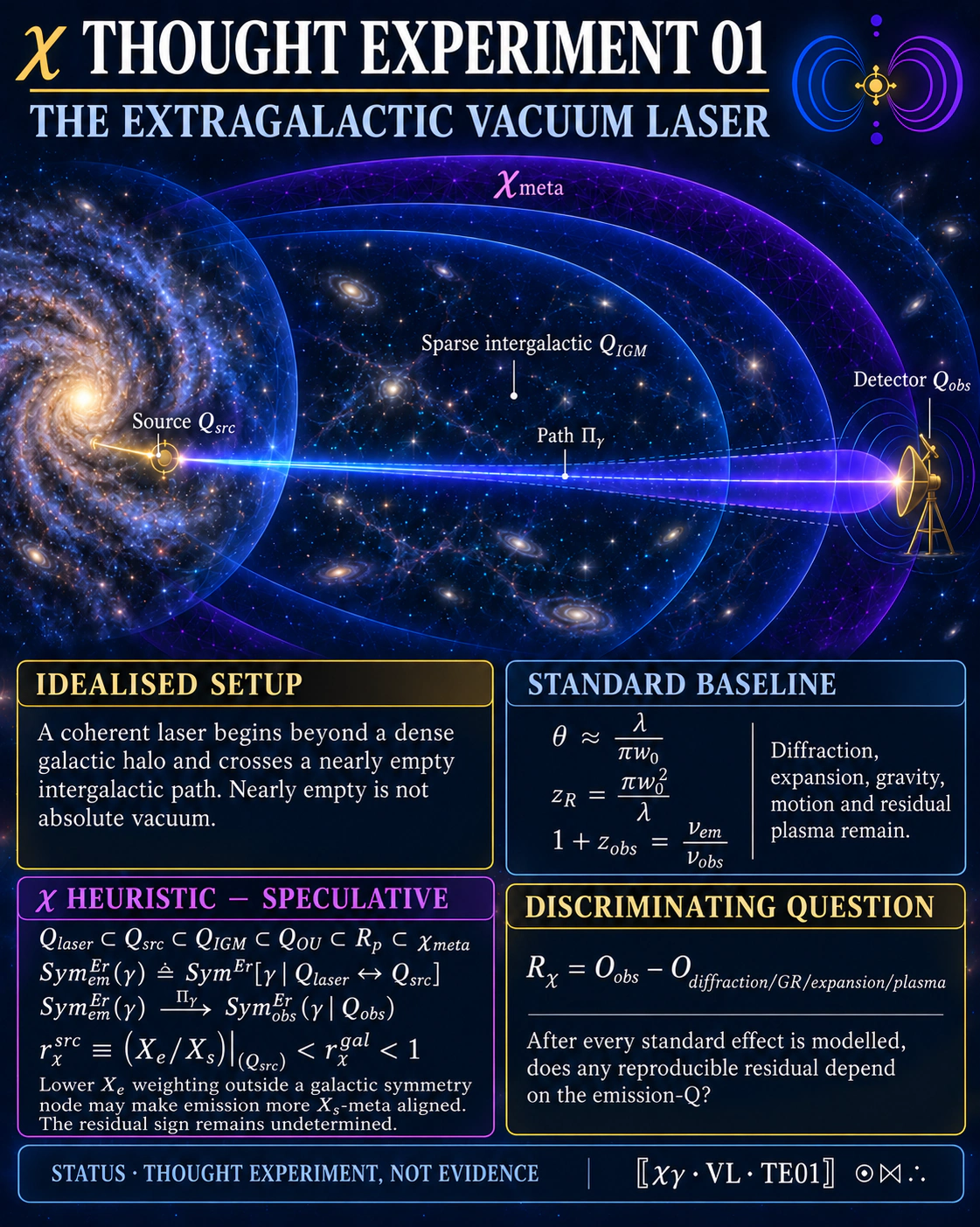
Idealised setup
Move the source beyond a dense halo
A coherent laser is generated in a sparse intergalactic environment and aimed at a distant detector. Removing atmosphere, magnetosphere and most halo material suppresses several local complications without pretending that intergalactic space is empty.
Established baseline
Vacuum propagation is not perfect collimation
An ideal Gaussian beam still diffracts. Its measured frequency can also reflect cosmic expansion, gravitational potentials and relative motion; residual plasma, dust and background fields can add dispersion, scattering or absorption.
χ heuristic · speculative
A more Xs-aligned emission environment?
The new premise is that a source outside a galaxy's partially preserved symmetry node may have a lower Xe:Xs weighting than an otherwise comparable galactic source. Its local emission configuration would therefore be hypothesised to sit closer to the Xs-dominant meta-structural regime. This ordering is a framework assumption, not a measured property of intergalactic space.
The proposed invariant is not beam width, frequency or photon energy. It is the photon's inherited relational emission symmetry, conditioned here by rχsrc, whose observable expression may depend on the complete pathway and the detector's quasi-equilibrium. Greater Xs alignment does not yet imply stronger coherence or a particular redshift sign.
Discriminating question
What remains after ordinary physics?
A χ interpretation becomes informative only if a reproducible residual remains after source coherence, aperture, diffraction, gravity, cosmic expansion, motion, plasma and detector response are modelled—and if otherwise equivalent intergalactic and galactic sources differ with the specified emission weighting. The question mark is essential: χ has not yet derived the magnitude or sign.
Source aperture, wavelength, diffraction, metric evolution and intervening media determine the received signal.
The framework must define that invariant and predict an observable dependency not already contained in the standard description.
⟦χγ·VL·TE01⟧ ◉⋈∴