
06 / The χ Framework
Where current research meets the χ Framework
Photon polarization and galaxy quenching
Established observational result
ACT finds no evidence for periodic rotation
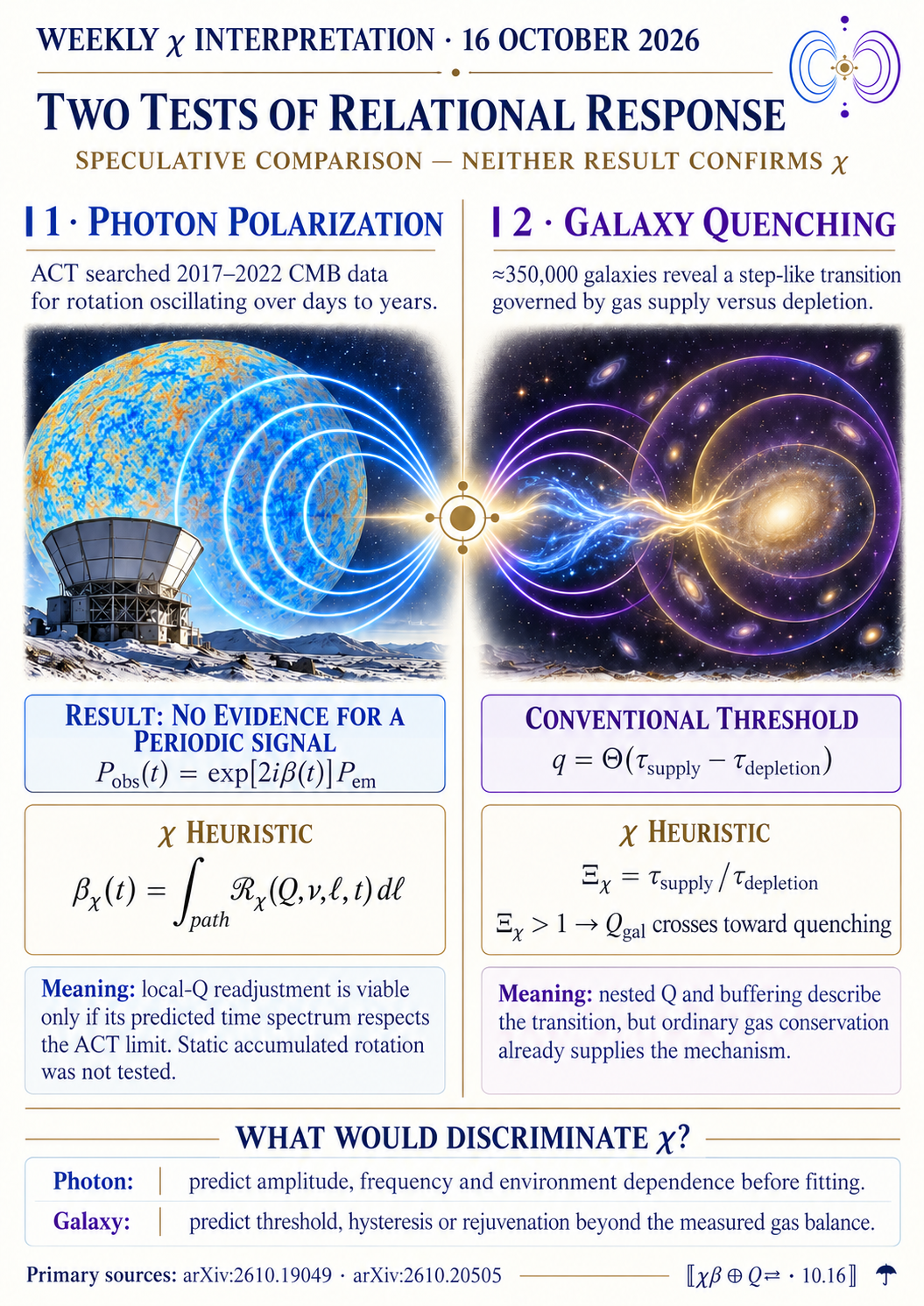
Using more than 10,000 time-sliced CMB polarization maps from 2017–2022, the ACT team searched for an isotropic rotation varying over periods from days to years. It found no evidence for that signal and set its strongest limits to date on axion–photon coupling under a stochastic axion-dark-matter assumption.
This constrains one particular time-dependent mechanism. It does not rule out constant birefringence, relational redshift or every possible propagation effect.
χ photon hypothesis · uncalibrated
Local-Q readjustment must respect the null result
If photon polarization readjusts to local quasi-equilibria, χ must specify the coupling and predict its temporal spectrum before fitting. Any predicted periodic component in ACT’s tested range must lie below the reported limit.
A static path-integrated term would require a different estimator. Rotation remains distinct from the framework’s proposed emission–observation frequency disparity.
Reported astrophysical analysis
Galaxy evolution shows a step-like threshold
A new study derives a step-like response from gas-mass conservation and applies it to about 350,000 galaxies. When replenishment cannot keep pace with depletion, star formation shuts down; the authors infer a characteristic supply timescale near 1 Gyr and distinguish inside-out from outside-in signatures.
The compact step function above is our classification heuristic, not the paper’s complete fitted model.
χ galactic hypothesis · descriptive bridge
A nested Q can cross a buffered transition
This maps neatly onto nested quasi-equilibria, buffering and non-monotonic reconfiguration: a galaxy may remain star-forming while inflow buffers depletion, then cross a threshold and later rejuvenate.
Ordinary gas conservation already supplies the mechanism. χ becomes explanatory only if it predicts an additional threshold, hysteresis or rejuvenation law rather than renaming the measured balance.
Primary research: Huber et al., ACT DR6 time-dependent cosmic birefringence ↗ · He et al., step-like galaxy quenching ↗
⟦χβ⊕Q⇌·10.16⟧ ☂︎
Previous weekly interpretations
Photon rotation as local relational readjustment?
Reported theoretical result
Different mechanisms leave different polarization patterns
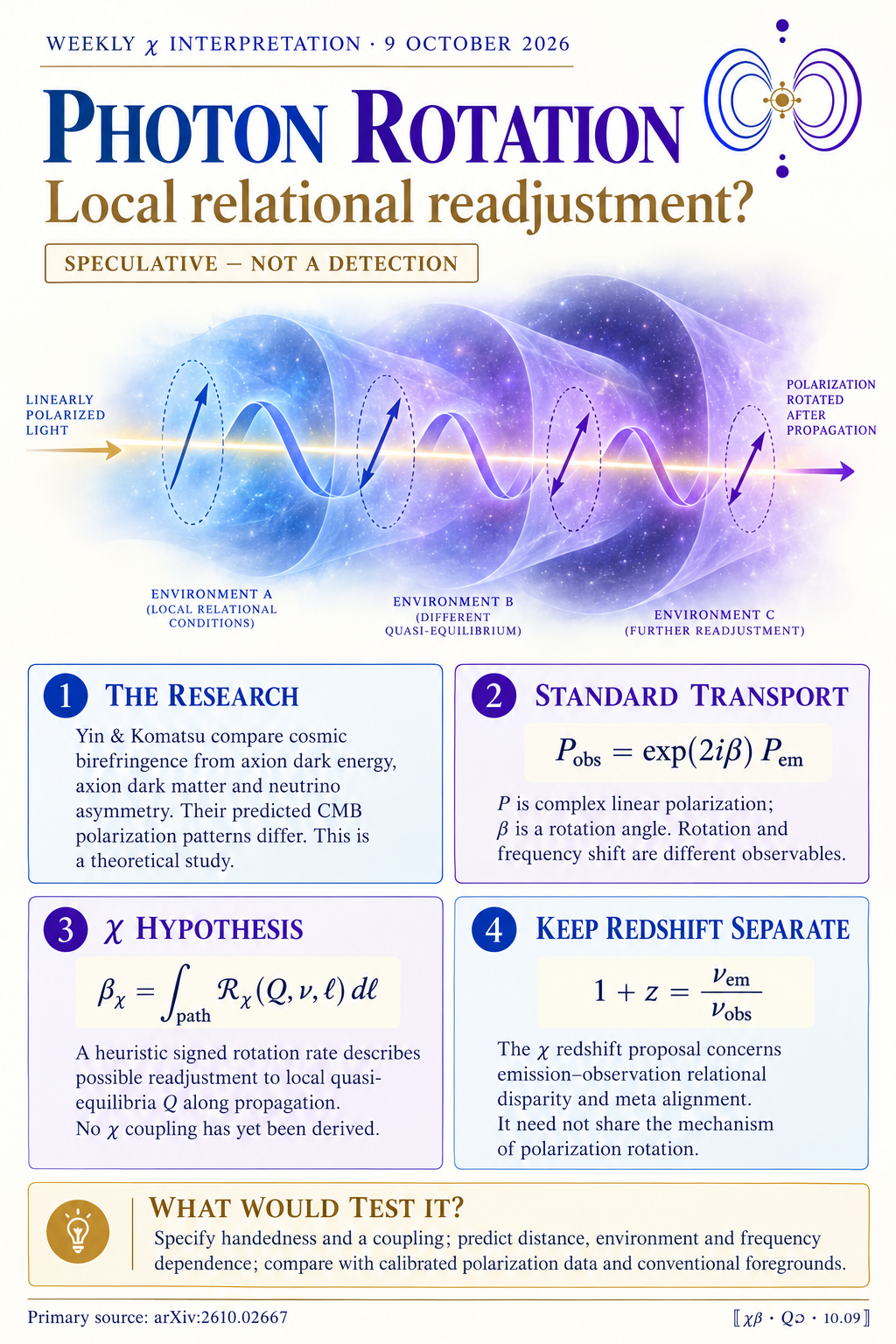
Yin and Komatsu’s 2 October preprint compares birefringence from axion dark energy, axion dark matter and neutrino asymmetry. Low-multipole suppression distinguishes the dark-matter and neutrino cases from dark energy; evolution during recombination further distinguishes neutrino asymmetry from axion dark matter. Future CMB polarization measurements could test these patterns.
This is a theoretical calculation, not a new observation or confirmation of cosmic rotation.
Conventional account
A physical coupling rotates polarization
For pure rotation, P = QSt + iUSt describes complex linear polarization and β is the angle. Stokes QSt is distinct from the framework’s quasi-equilibrium Q. The paper models specific parity-sensitive couplings; it does not invoke χ or relational redshift.
χ hypothesis · uncalibrated heuristic
Readjustment to local Q along the path
In this proposed interpretation, polarization may readjust to local relational energy configuration over long propagation distances. ℛχ is a signed rotation rate per unit proper length; ν is local frequency and ℓ labels the path. This integral defines a candidate description, not a derived law.
A scalar alignment variable alone does not specify handedness. χ must identify an oriented or parity-sensitive physical degree of freedom, its coupling, and how the rate follows from Q and χ.
Discriminating prediction
Predict before fitting
Specify distance, epoch, frequency and line-of-sight environment dependence, then predict CMB polarization correlations or rotation in independently calibrated sources. Compare with the paper’s conventional mechanisms, instrumental angle errors, foregrounds and Faraday rotation. A free kernel adjusted separately to every source is not a test.
A null result or incompatible pattern rejects that specified χ rotation model; it need not reject a separate redshift hypothesis.
Proposed local-Q readjustment during propagation. Its sign, mechanism and accumulation require explicit dynamics.
The χ proposal connects emission–observation relational disparity and meta alignment to frequency change. This speculative interpretation must reproduce standard gravitational, Doppler and cosmological tests; rotation does not establish it.
Primary research: Yin & Komatsu, “Distinguishing the origin of cosmic birefringence: dark energy, dark matter, and neutrino asymmetry” ↗
⟦χβ·Q↻·10.09⟧
A cosmic gravitational glitch across nested equilibria?
Reported fit
One parameter can match the DESI preference
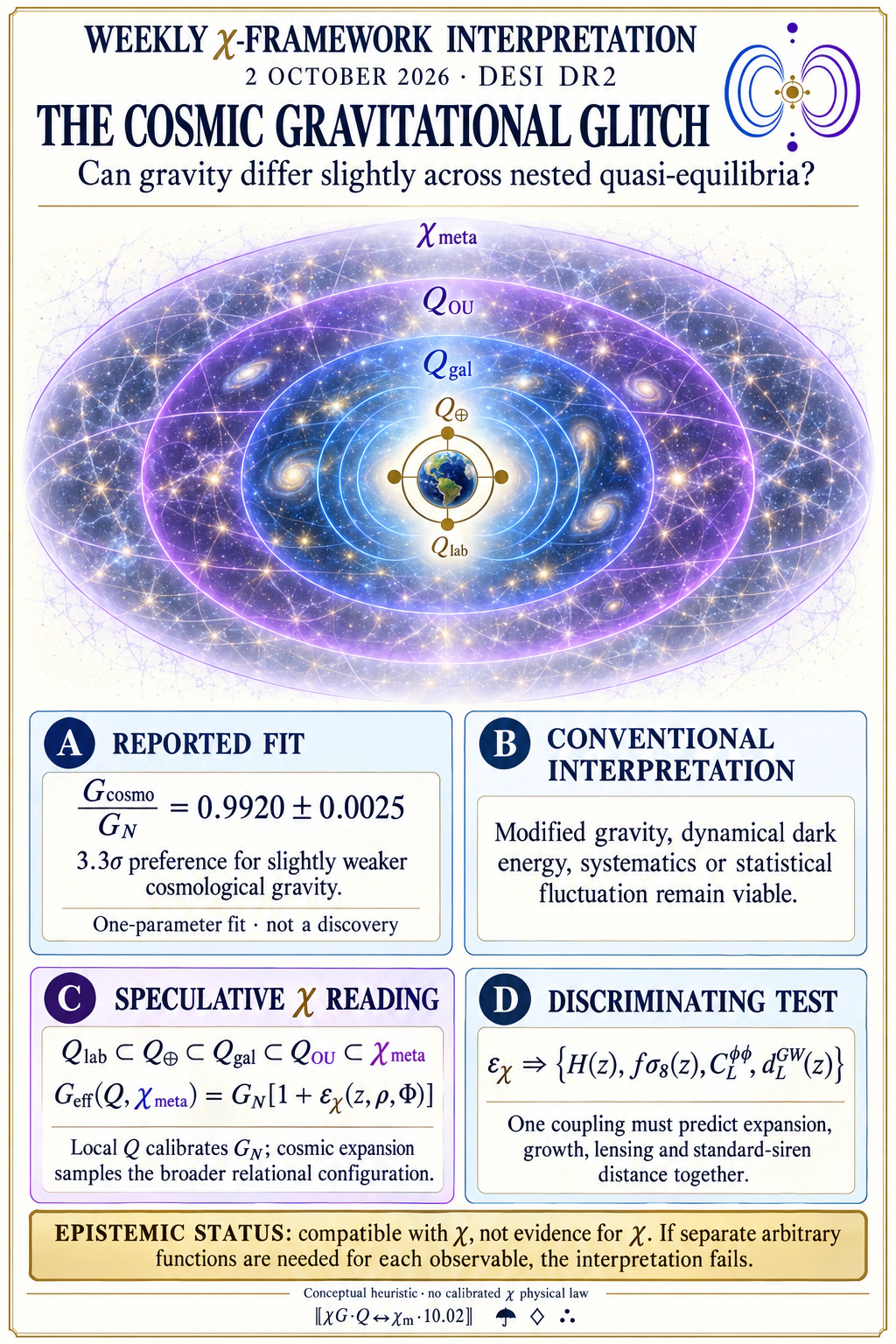
A 30 September analysis of DESI DR2 BAO and CMB data reports a 3.3σ preference for slightly weaker cosmological gravity. Its one-parameter “cosmic glitch” fits at least as well as the two-parameter w0wa description. This is a model-dependent preference, not a detection that gravity has changed.
Conventional interpretation
Modified gravity competes with evolving dark energy
The same distance pattern may reflect modified gravity, dynamical dark energy, residual systematics or statistical fluctuation. A viable gravity model must also satisfy gravitational-wave speed, preferred-frame, stability and local-gravity constraints.
χ hypothesis boundary
Local calibration within a larger relational context
The speculative χ reading is that local experiments calibrate gravity inside nested quasi-equilibria, while cosmological expansion samples their relationship with the wider Xs-dominant meta structure. The proposal is not that each Q has an arbitrary gravity law.
Discriminating prediction
One coupling must close across observables
The same restricted εχ must jointly predict expansion, structure growth, CMB lensing and standard-siren distance. Separate adjustable functions for each dataset would make the interpretation descriptive rather than explanatory.
Laboratory, Solar-System and binary-pulsar tests already impose tight limits. χ must recover them rather than treating them as irrelevant local approximations.
The possible signal would be a coherent cross-observable scaling, not an unconstrained time-varying constant inserted after the measurements are known.
Primary research: Zuntz et al., “Is DESI Seeing Dynamical Dark Energy, or a Cosmic Glitch in Gravity?” ↗
⟦χG·Q↔χₘ·10.02⟧ ☂︎◇∴
Local field dependency and scale-nested radio propagation
Reported proposal
An environment-dependent effective photon mass
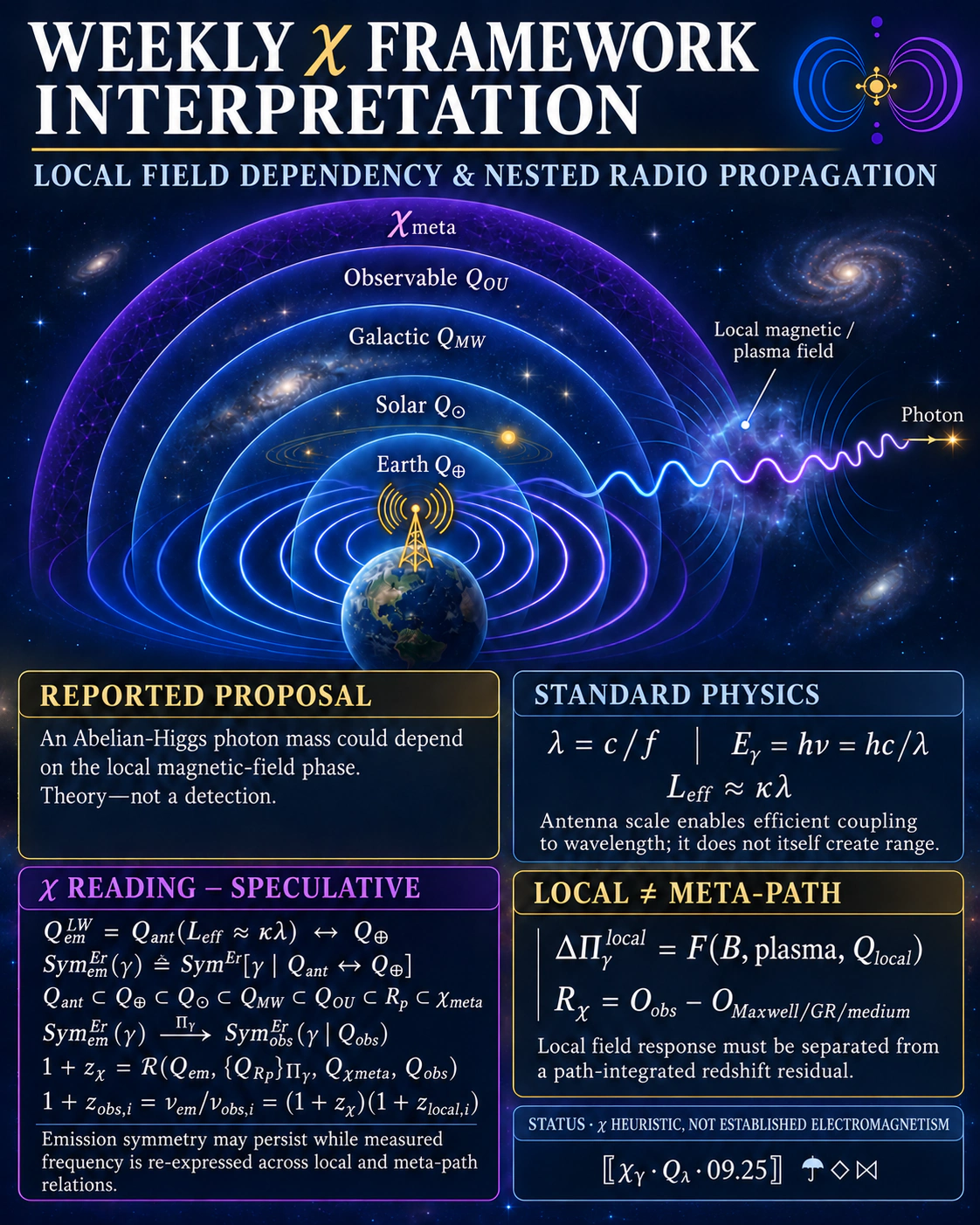
A new theoretical study considers photon mass generated through an Abelian Higgs mechanism. The ambient magnetic field can place the additional field in symmetry-restored, Meissner or vortex phases, so different environments can have different sensitivity to—or expressions of—an effective photon mass. No photon mass was detected.
Conventional account
Antenna scale is coupling, not a range generator
For some resonant antenna designs, efficient dimensions scale with wavelength. Lower-frequency radio can sometimes propagate over long distances through ground-wave travel, diffraction or ionospheric reflection, but range also depends on power, noise, absorption, plasma, terrain and atmospheric conditions. A larger antenna does not itself make a wave travel farther.
χ hypothesis boundary
Emission symmetry begins locally
The speculative bridge is that the antenna is a comparatively large, phase-organised source-Q inside Earth’s local quasi-equilibrium. It prepares the photon’s emission relation at wavelength λ; it does not free the photon from Maxwellian electrodynamics or from Q⊕.
This supplies a χ scale analogy—large-scale source coherence ↔ long wavelength—nested within progressively broader Q, not a replacement for antenna theory.
Two distinct χ effects
Preservation is not unchanged measured energy
The photon is proposed to preserve a relational-energy symmetry inherited at emission, while its detected frequency is re-expressed relative to Qobs. The provisional factorisation combines the shared meta-path contribution with a source-, observer- and environment-dependent local term, which may include redshift or blueshift. The local pathway equation remains distinct: it assigns magnetic or plasma response to nearby Q rather than automatically to zχ.
A large resonant source can efficiently couple to a long wavelength. Magnetic and plasma conditions may then change opacity, polarization or permitted modes without supplying a cosmological redshift mechanism.
The χ redshift proposal concerns the photon’s inherited emission alignment being re-expressed through nested persistent equilibria across the complete propagation history.
Primary research: Gruzinov, Hook & Huang, “The universe as a superconductor: How to search for a photon mass” ↗
⟦χγ·Qλ·09.25⟧ ☂︎◇⋈
Earlier interpretation
Massive-state relational differentiation
Reported proposal
What the paper actually says
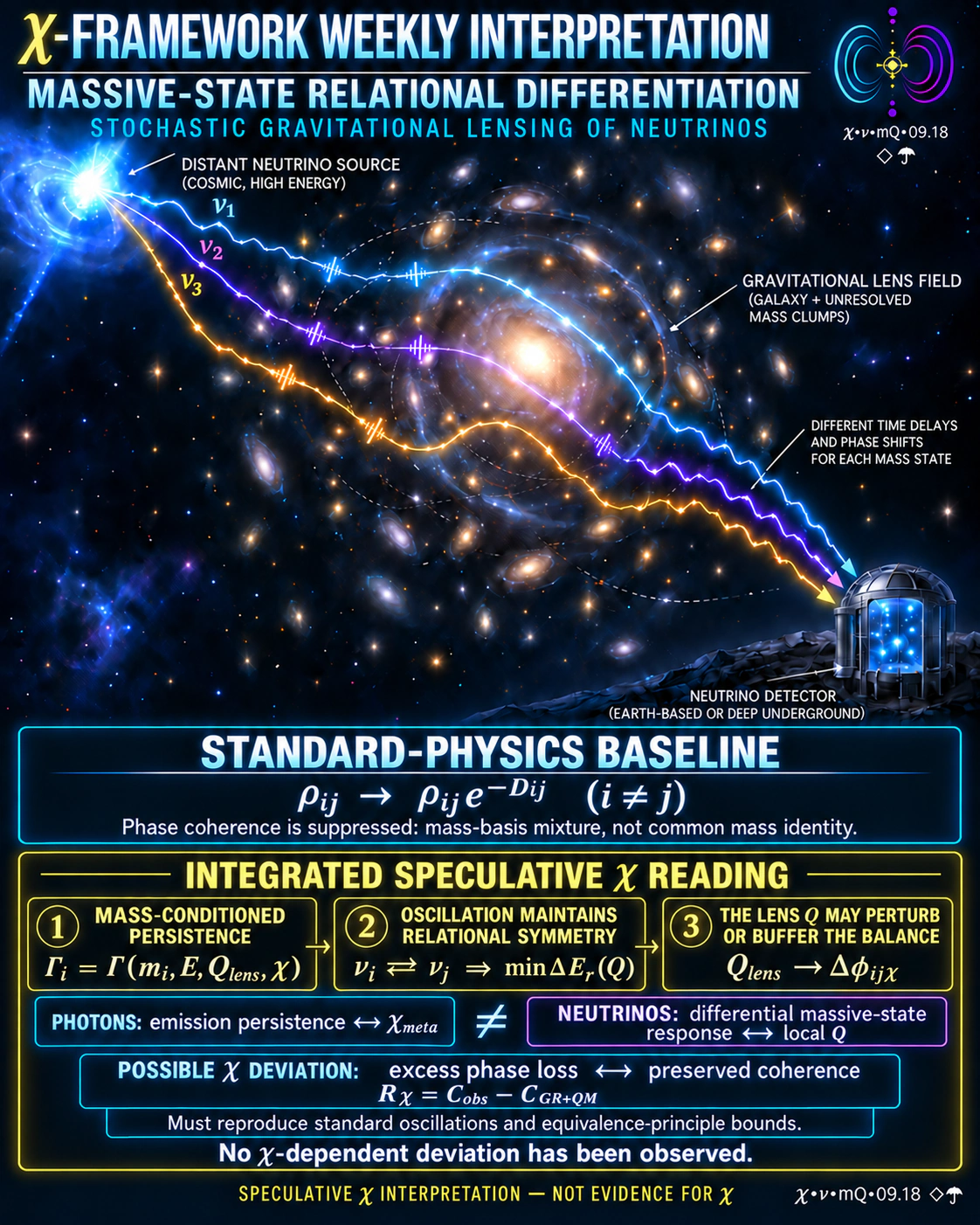
Unresolved compact structures in a gravitational lens could perturb neutrino time delays. Different mass eigenstates would then accumulate random relative phases, reducing observable flavour coherence after averaging over the unknown lens configurations.
Conventional account
Decoherence is not convergence to one mass
The proposed effect follows from gravitational time delay, lens substructure and ordinary neutrino phase evolution. The off-diagonal phase relationships are suppressed, producing an incoherent mixture in the mass basis—not a common mass identity. The component masses and populations remain distinct.
χ hypothesis boundary
Integrated speculative mechanism
- Mass-conditioned persistenceΓi = Γ(mi, E, Qlens, χ)
Each massive eigenstate may preserve relational configuration differently.
- Oscillatory maintenanceνi ⇄ νj ⇒ min ΔEr(Q)
Oscillation may maintain relational-energy symmetry among those components.
- Lens perturbation or bufferingQlens → Δφijχ
The lens quasi-equilibrium may disrupt or help preserve the balance.
Discriminating test
What χ would need to add
A distinctive prediction could have either sign: unexpectedly rapid phase loss or unexpectedly preserved coherence after lens mass, neutrino energy, distance and ordinary oscillation are modelled. No such χ-dependent deviation has been observed.
Relational redshift concerns a massless photon’s preserved emission relationship interacting with the evolving meta-structure. Local-Q adjustment may instead affect polarization.
Oscillation concerns phase differences between massive eigenstates. A χ contribution would have to modify those differences beyond GR and standard quantum evolution.
Primary research: Acharya & Dey, “Gravitational lensing of neutrinos through the lens of decoherence” ↗
χ•ν•mQ•09.18 ⟡☂