
02 / The χ Framework
Small axioms. Wider connections.
The key working assumptions behind the framework, with a compact heuristic beside each one.
Latest · Addendum 41b
Observable universe ↔ Rp
Pre-existing χmeta configurations are proposed to make PES possible; PES forms Rp, observed as the evolving observable universe.
Read Addendum 41b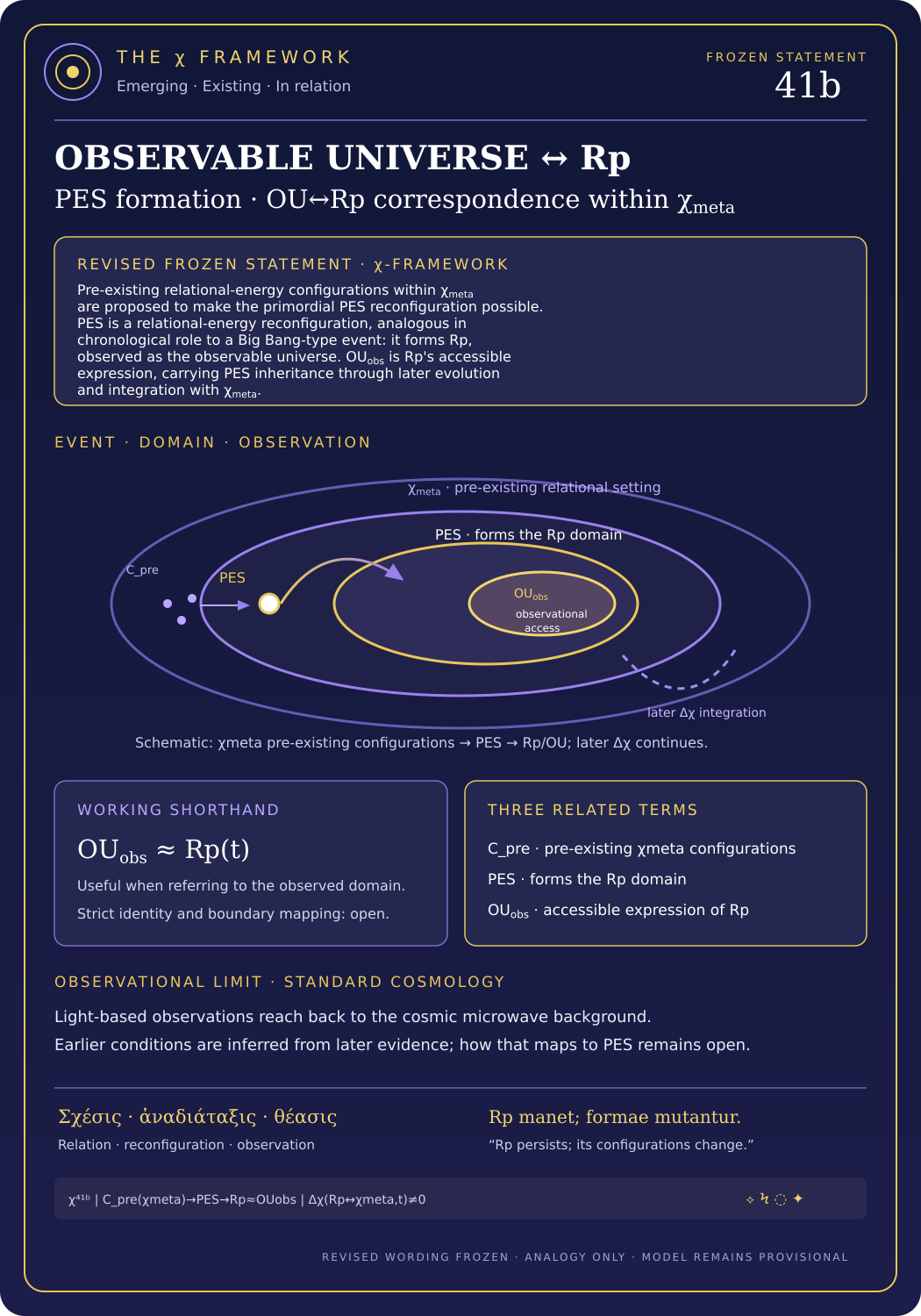
Emergence has a pre-existing context
The meta structure, χ_meta, is proposed to pre-exist our observable universe. A primordial extreme symmetry process emerges within its relational configurations; it does not create the entire meta structure from nothing.
⟐χ₁Extreme symmetry remains approximate
Xe and Xs approach near equality during a primordial extreme symmetry process. Absolute symmetry is excluded as a working assumption. The process is temporary and is followed by a move toward existing-dominant configurations.
⟐χ₂An evolving boundary can retain its origin
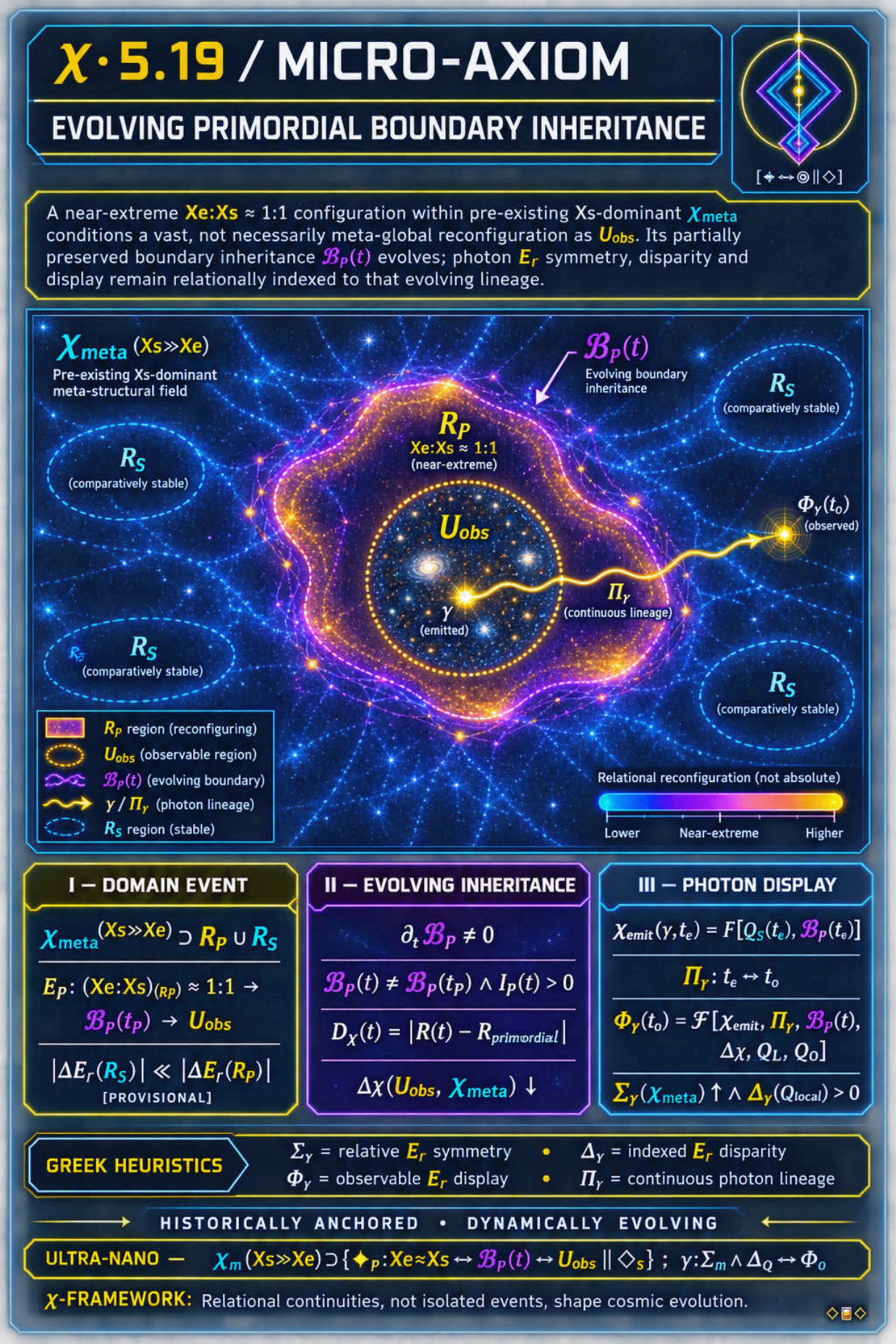
The observable universe is treated as a partially preserved node of the primordial process. Its Rₚ reconfiguration domain carries an evolving, partially preserved boundary condition while integrating with the wider meta structure.
⟐χ₃Integration need not erase relational history
Relational homogenisation may increase existing weighting while earlier configurations remain partially expressed. Greater energetic uniformity need not imply lower relational complexity; the two ideas must be defined separately.
⟐χ₄Quasi-equilibria are nested and local
Galaxies, stars, planets and matter are proposed to sustain different local quasi-equilibria, Q, within larger relational environments. A local Xe:Xs weighting is context-dependent; the framework does not require identical ratios at different scales.
⟐χ₅Similar configurations can have distinct histories
Galaxies may share aspects of their primordial origin while following unique formation and integration trajectories. Similarity in relational configuration does not, by itself, establish proximity in space, instantaneous communication or identical evolution.
⟐χ₆Photon observations may combine several histories
The framework proposes that emission configuration, a lens's configuration and ongoing integration may jointly shape observed photon signatures. Its relational interpretation of redshift and lensing remains a hypothesis requiring quantitative predictions.
⟐χ₇Transient configurations may reflect local calibration
Short-lived massive bosons are tentatively interpreted as local configurations with partial affinity to a primordial near-symmetry condition. Their formation and decay may reflect the surrounding quasi-equilibrium, without recreating the primordial process.
⟐χ₈Redistribution may preserve relational continuity
Black-hole evaporation is explored as a possible route toward integration with an existing-dominant environment. The framework asks whether relational information can persist through reconfiguration; it does not claim to have resolved the black-hole information problem.
⟐χ₉Stability is conditional across nested boundaries
Every quasi-equilibrium is proposed to be stable only relative to its nested boundary conditions: its local surroundings, the observable universe's partially preserved boundary condition and the wider Xs-dominant meta structure. Compatibility, not duration alone, sustains relative stability. A sufficiently large external primordial extreme-symmetry event might radically recalibrate these conditions, but that possibility and its effects remain underdetermined.
⟐χ₁₀⌁Photon redshift may resolve persistent equilibria
A redshifted photon is proposed to retain an encoding of its emission boundary while its observed energy reflects simultaneous coupling among the source quasi-equilibrium, the evolving Rₚ propagation boundary, the Xs-dominant meta structure and the observer's local equilibrium. Redshift is therefore explored as relational recalibration rather than simple frictional energy loss.
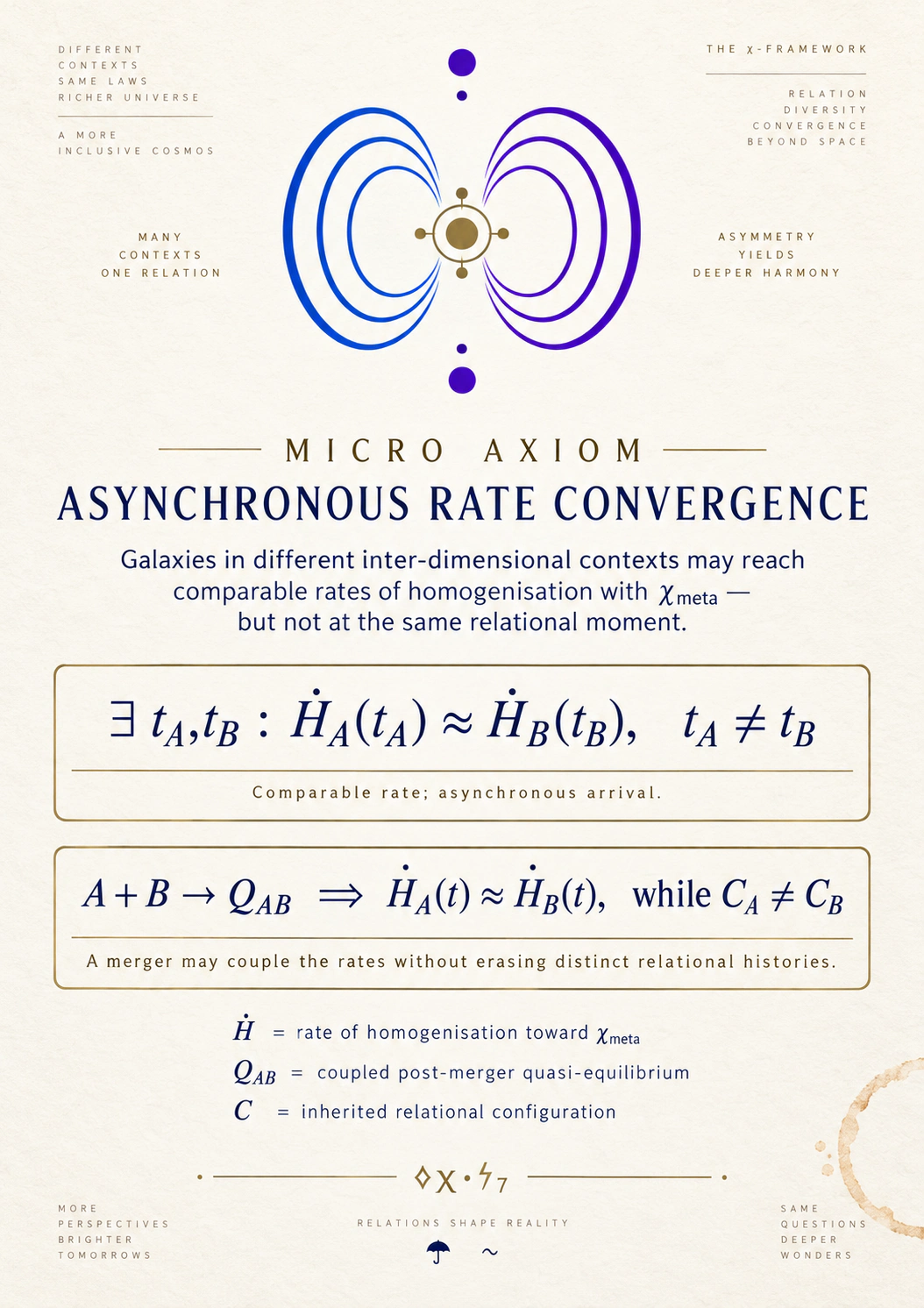
⟦℘γ·χₓ⟧ · ☂︎⋈◇◇Comparable homogenisation rates need not be simultaneous
Galaxies in different inter-dimensional contexts may pass through comparable rates of homogenisation with χ_meta at different relational moments. During a merger, a coupled quasi-equilibrium may bring their rates very close without erasing their distinct inherited configurations or relational histories.
⟡χ·ϟ₇ · ☂⌁Shared contexts do not erase local relational identity
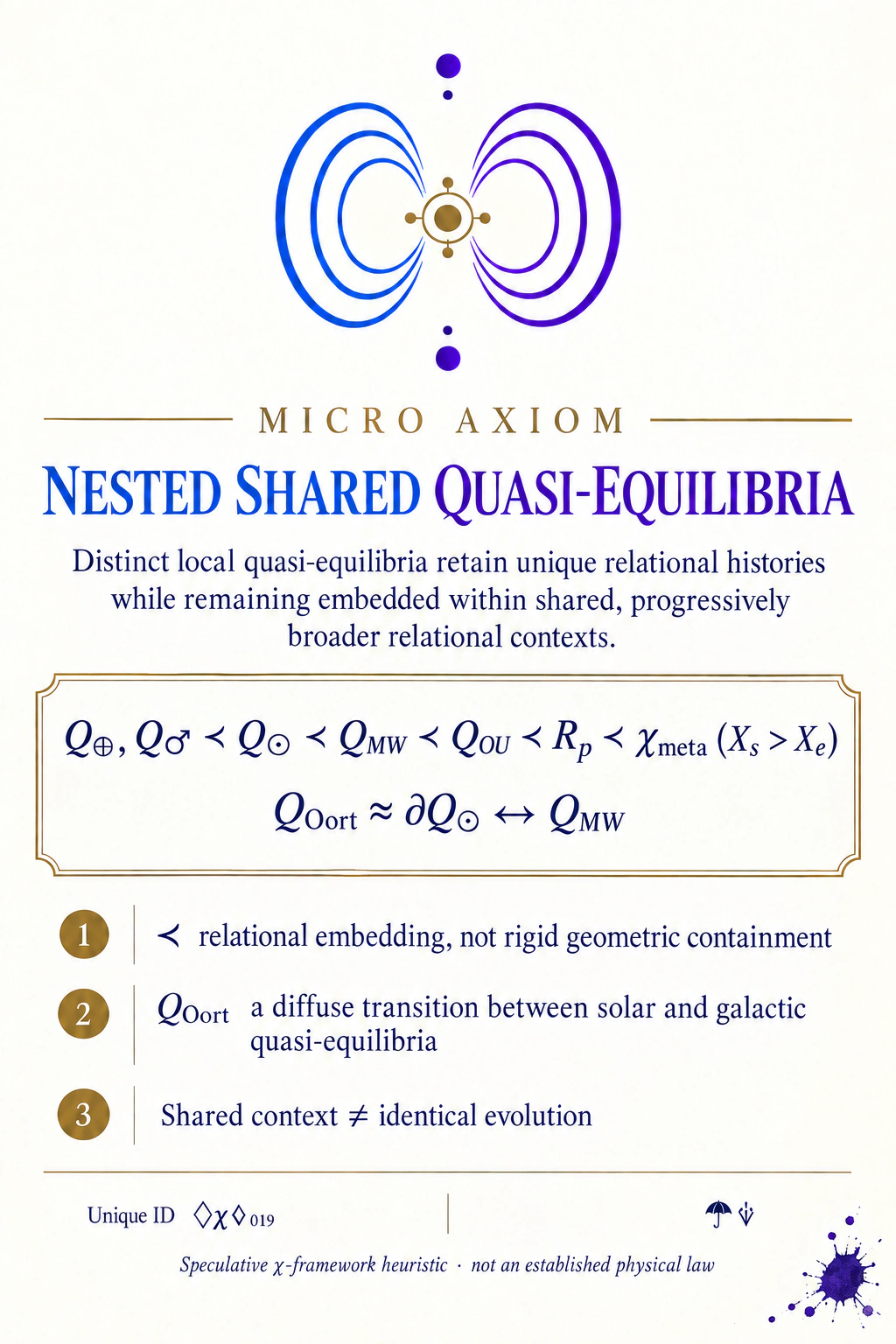
Earth and Mars are interpreted as unique planetary quasi-equilibria embedded within progressively broader shared relational contexts: the Solar System, the Milky Way, the observable universe, its primordial reconfiguration domain and the wider Xs-dominant meta structure. Each local Q can retain a distinct relational history while participating in the same larger equilibria.
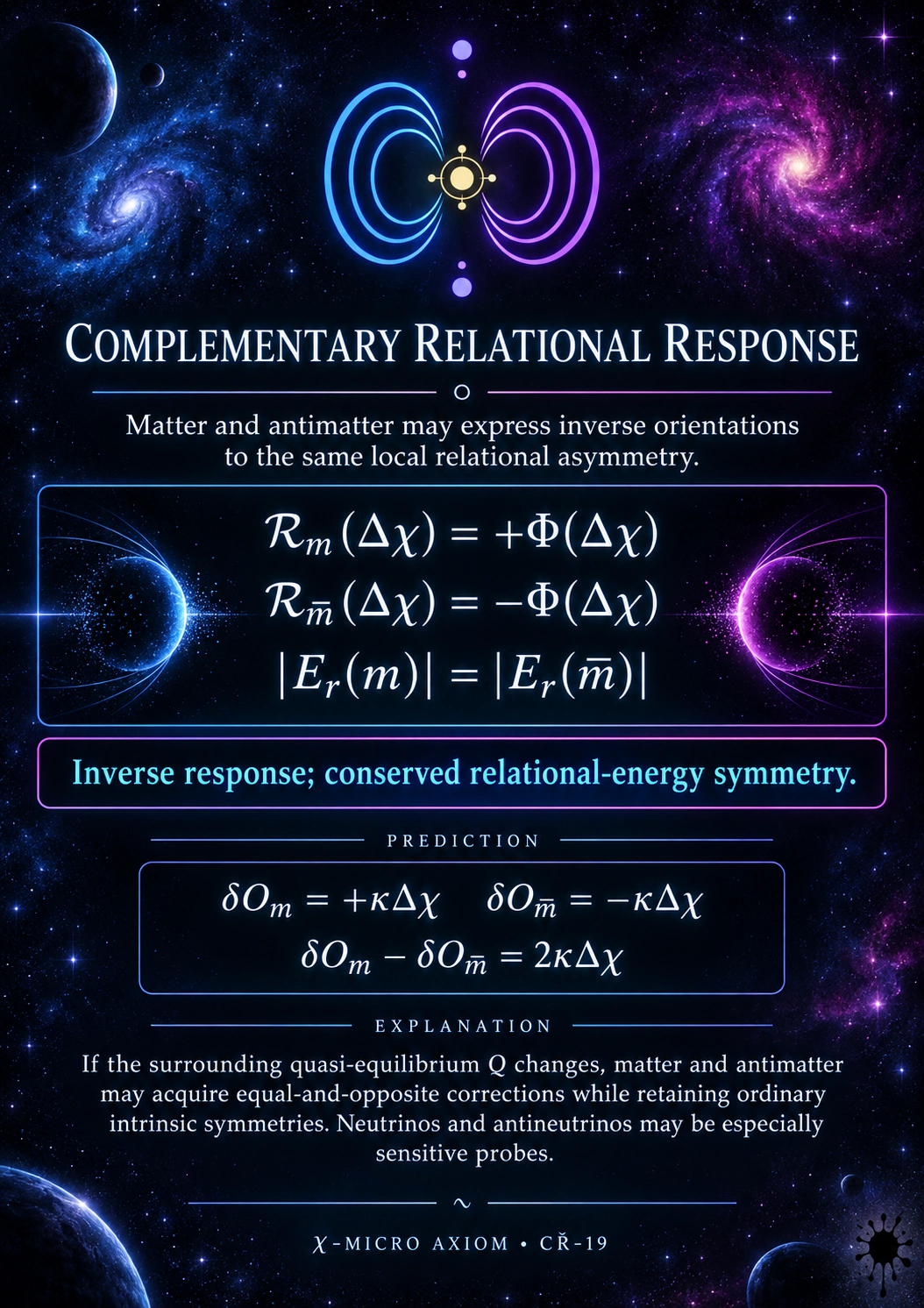
⌬χ⟡₀₁₉ · ☂︎⋔Matter and antimatter may respond in complementary orientations
Matter and antimatter are provisionally interpreted as equal-magnitude, oppositely oriented responses to the same local relational asymmetry. Antimatter is therefore not assumed to be intrinsically closer to primordial extreme symmetry; both configurations may preserve relational-energy symmetry while responding inversely to a changing quasi-equilibrium.
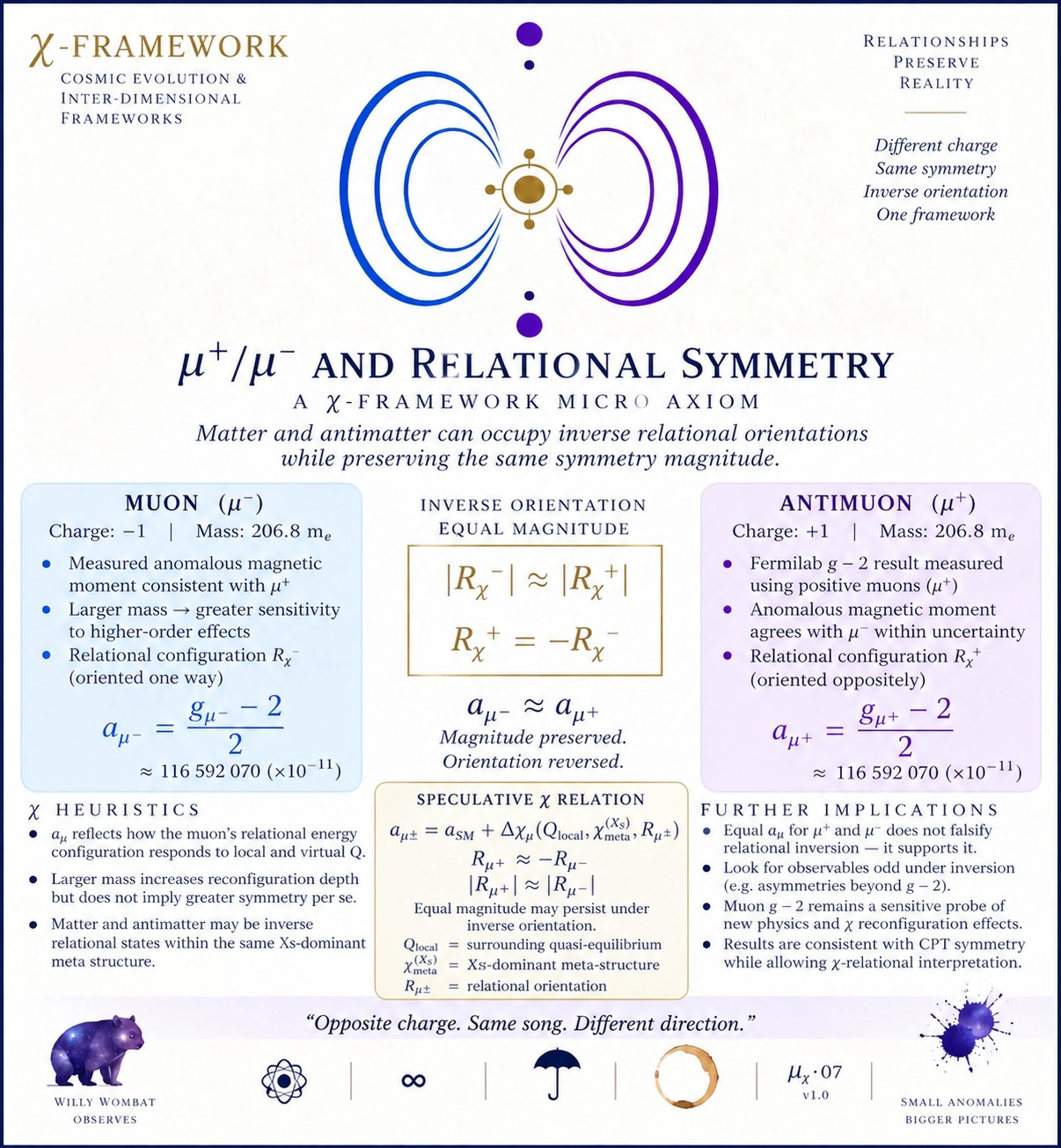
CŘ-19 · ⌁Equal anomalies may conceal inverse relational orientation
The closely matching anomalous magnetic moments of the muon and antimuon are provisionally interpreted as compatible with equal relational-symmetry magnitude and inverse orientation. The speculative adjustment is explicitly conditioned by the surrounding local quasi-equilibrium, the Xs-dominant meta-structure and the particle's relational orientation.
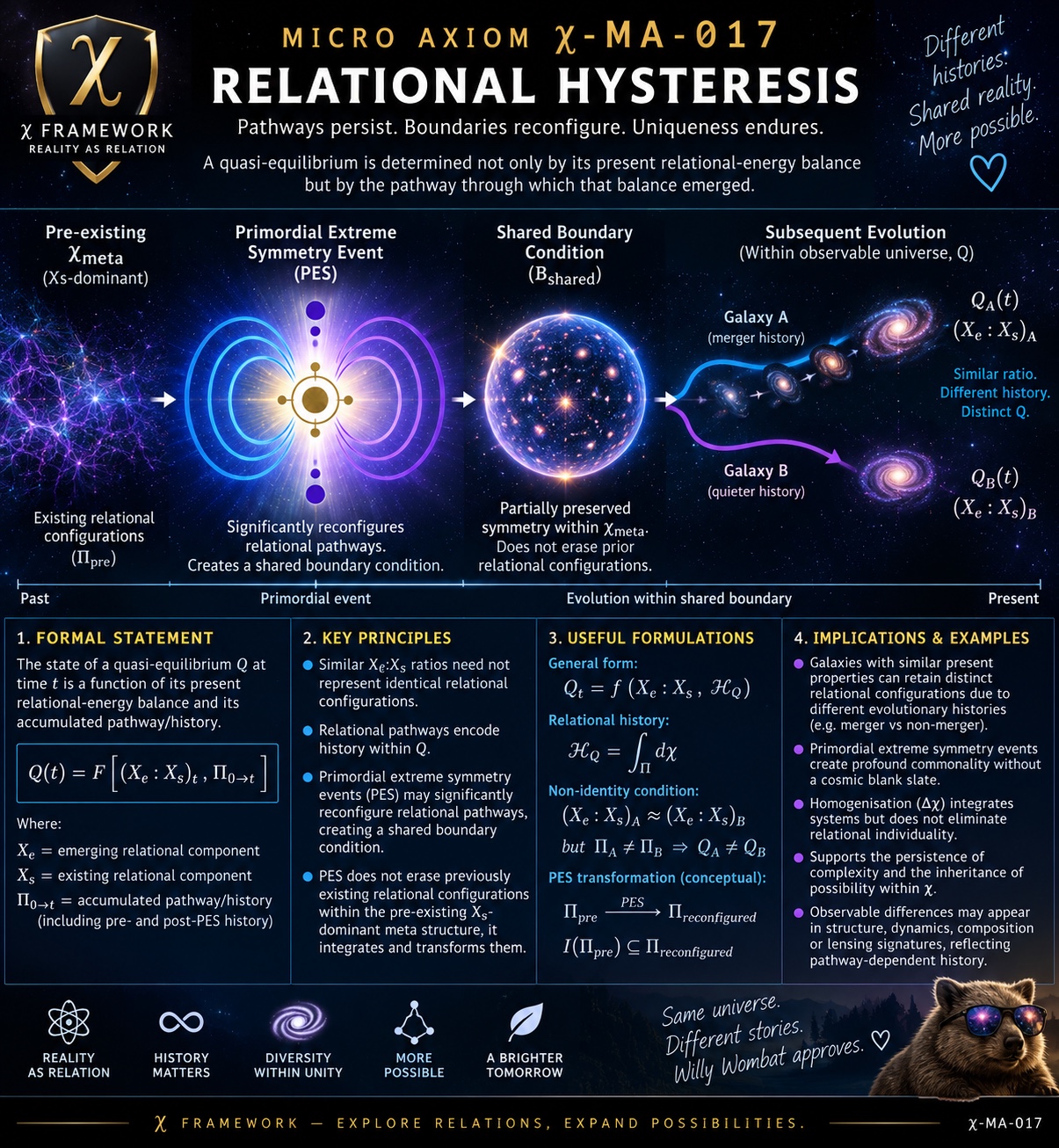
μχ·07 · ∞☂Present balance does not erase the pathway that produced it
A quasi-equilibrium is proposed to depend on both its present relational-energy balance and its accumulated pathway. Two galaxies may therefore display similar present Xe:Xs ratios while retaining different relational configurations because one followed a merger history and the other a quieter evolutionary history.
χ-MA-017 · ∞☂♡Primordial boundary inheritance can remain dynamic
A primordial near-symmetry event within the pre-existing Xs-dominant meta structure is proposed to establish an Rₚ reconfiguration domain and an inherited boundary condition. The initiating event can be complete while B_Rp(t) continues to evolve as the observable universe integrates with χ_meta. Preservation therefore means continuity of relational lineage, not a frozen shell.
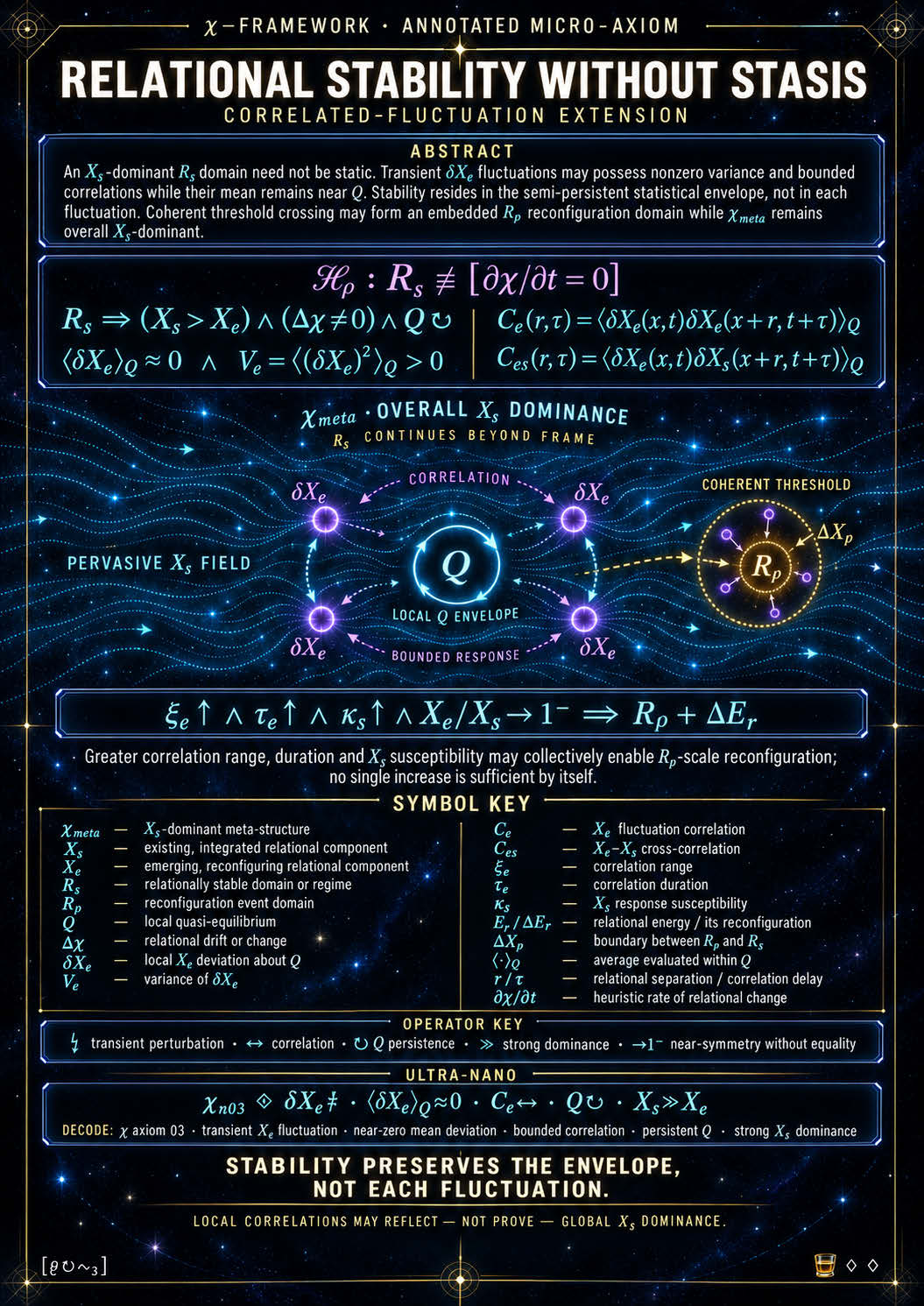
χ·5.19 · ◇☂Stability preserves an envelope, not every fluctuation
An Xs-dominant Rₛ region need not be static. Local Xe fluctuations and Q-level reconfigurations may occur while their mean remains bounded and the wider relational envelope persists. A sufficiently coherent threshold crossing may form an embedded Rₚ reconfiguration domain without overturning χ_meta's overall Xs dominance.
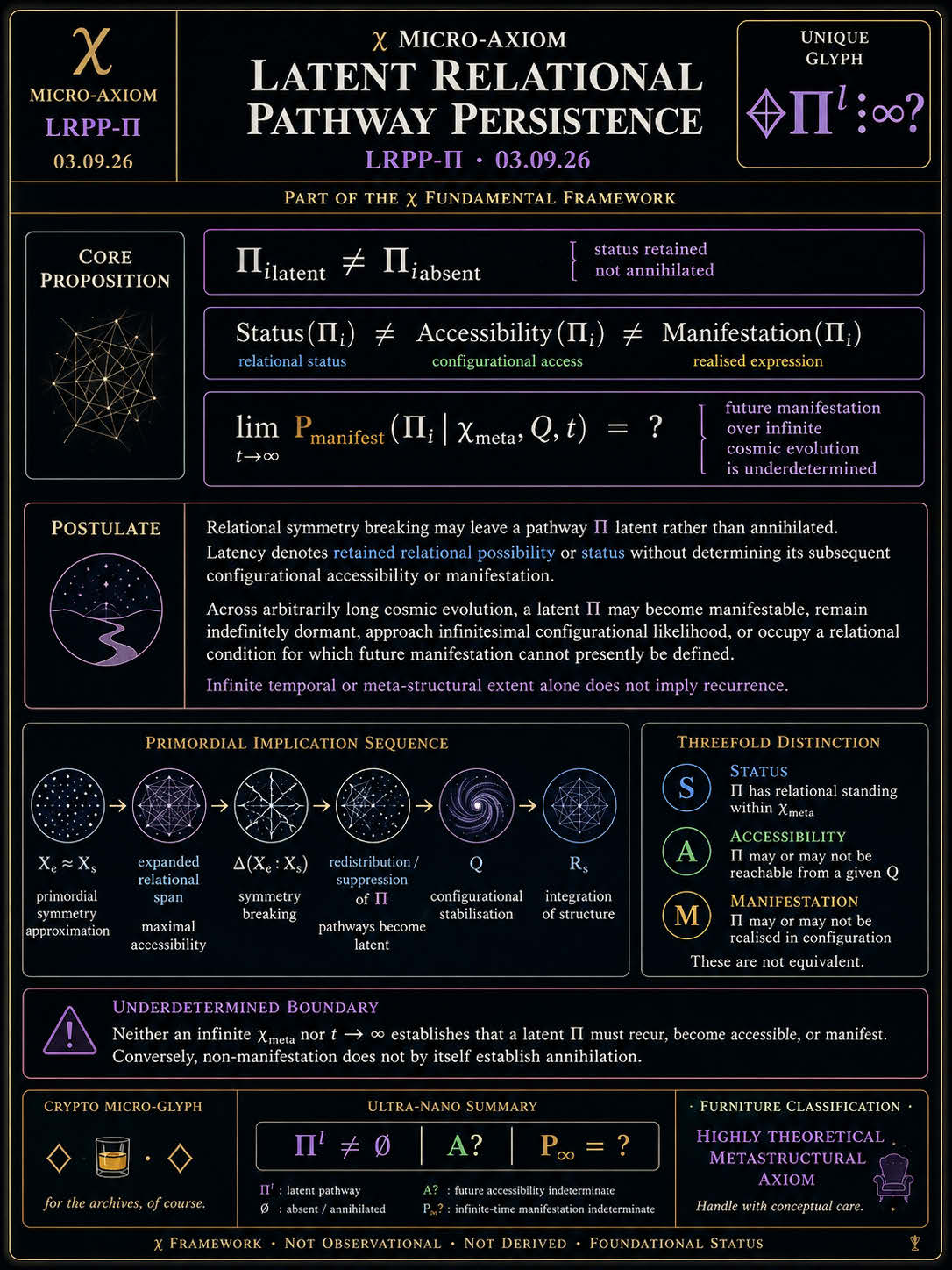
χₙ₀₃ · ◇↔A latent pathway is not an absent pathway
Relational symmetry breaking may leave a pathway Π latent rather than annihilated. Latency denotes retained relational possibility or status within χ_meta; it does not guarantee accessibility from a given Q or manifestation in a realised configuration. A latent Π may later become accessible, remain dormant, approach negligible configurational likelihood or remain presently undefined.
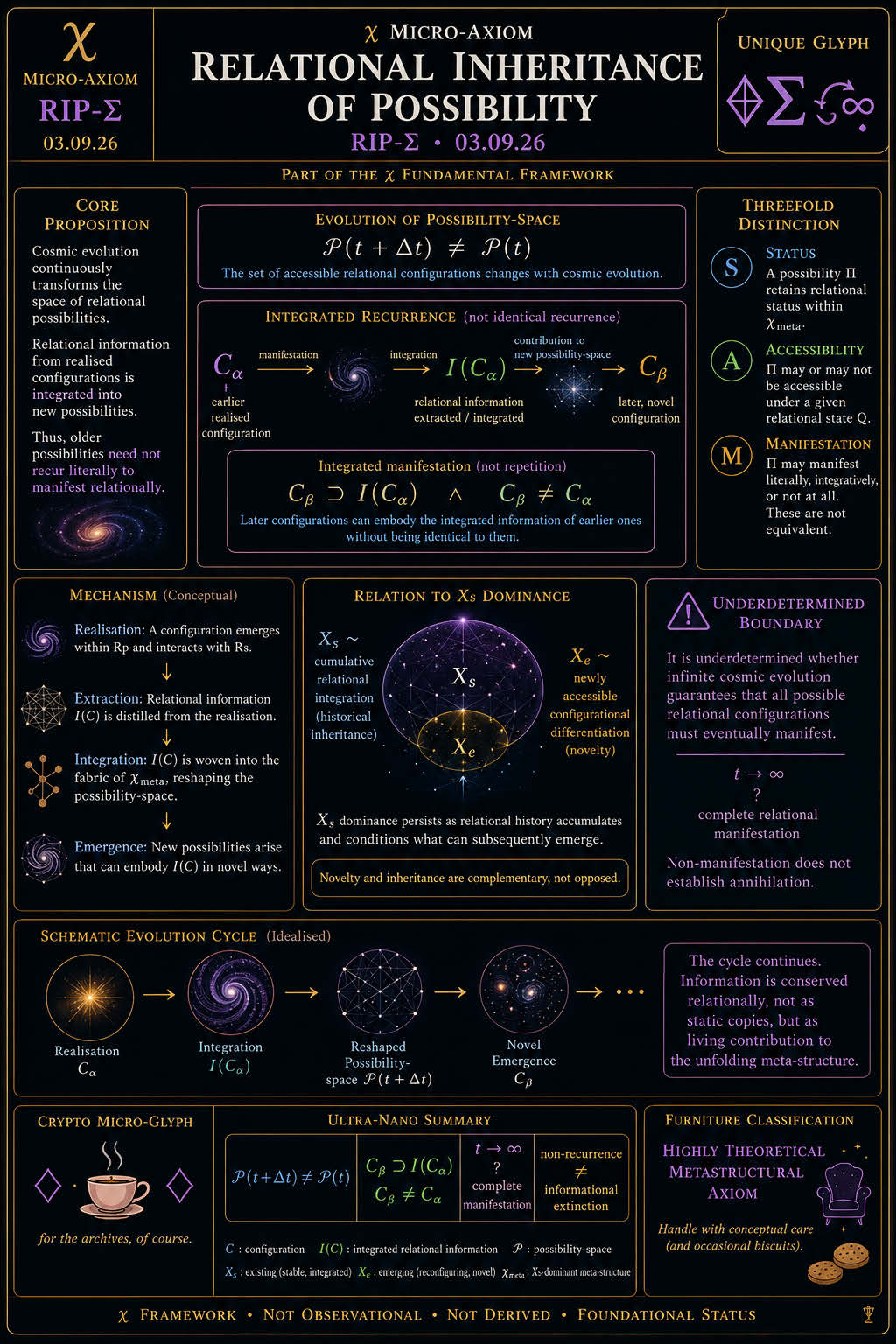
LRPP-II · ◇Πˡ∞?Novelty can inherit without repeating
Each realised configuration Cα is proposed to contribute integrated relational information I(Cα) to the evolving possibility-space. A later configuration Cβ may embody that contribution while remaining genuinely non-identical to Cα. Inheritance therefore supplies continuity without literal recurrence: accumulated Xs history can condition new Xe differentiation rather than oppose novelty.
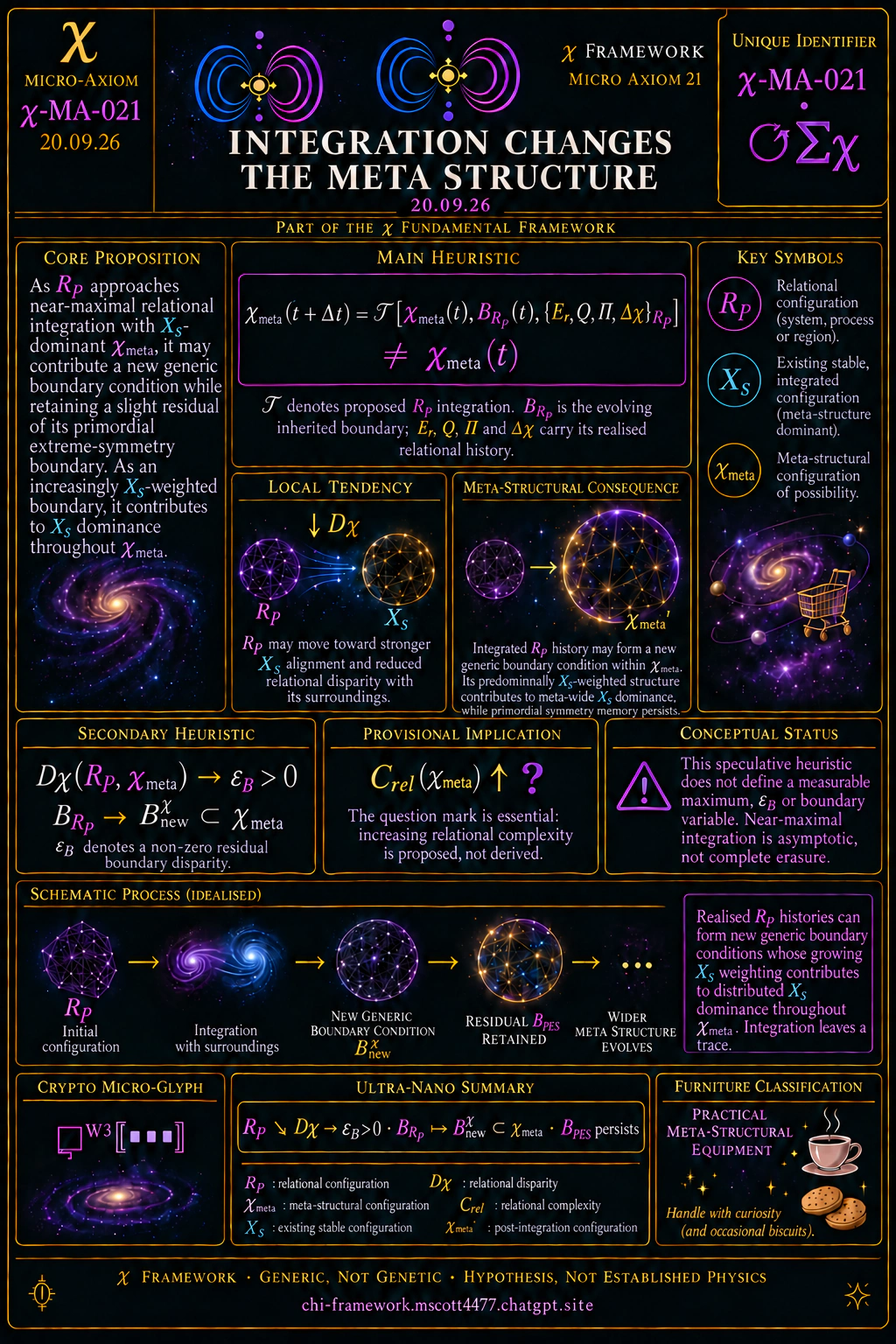
RIP-Σ · ◇Σ↻∞Integration changes the meta structure
As the observable universe's Rₚ domain approaches near-maximal relational integration with Xs-dominant χ_meta, it may contribute a new generic boundary condition to the wider meta structure while retaining a slight residual of its primordial extreme-symmetry boundary. As an increasingly Xs-weighted boundary, it contributes to the distributed Xs dominance throughout χ_meta while preserving primordial symmetry memory.
χ-MA-021 · ⟲ΣχEntropy growth need not erase relational complexity
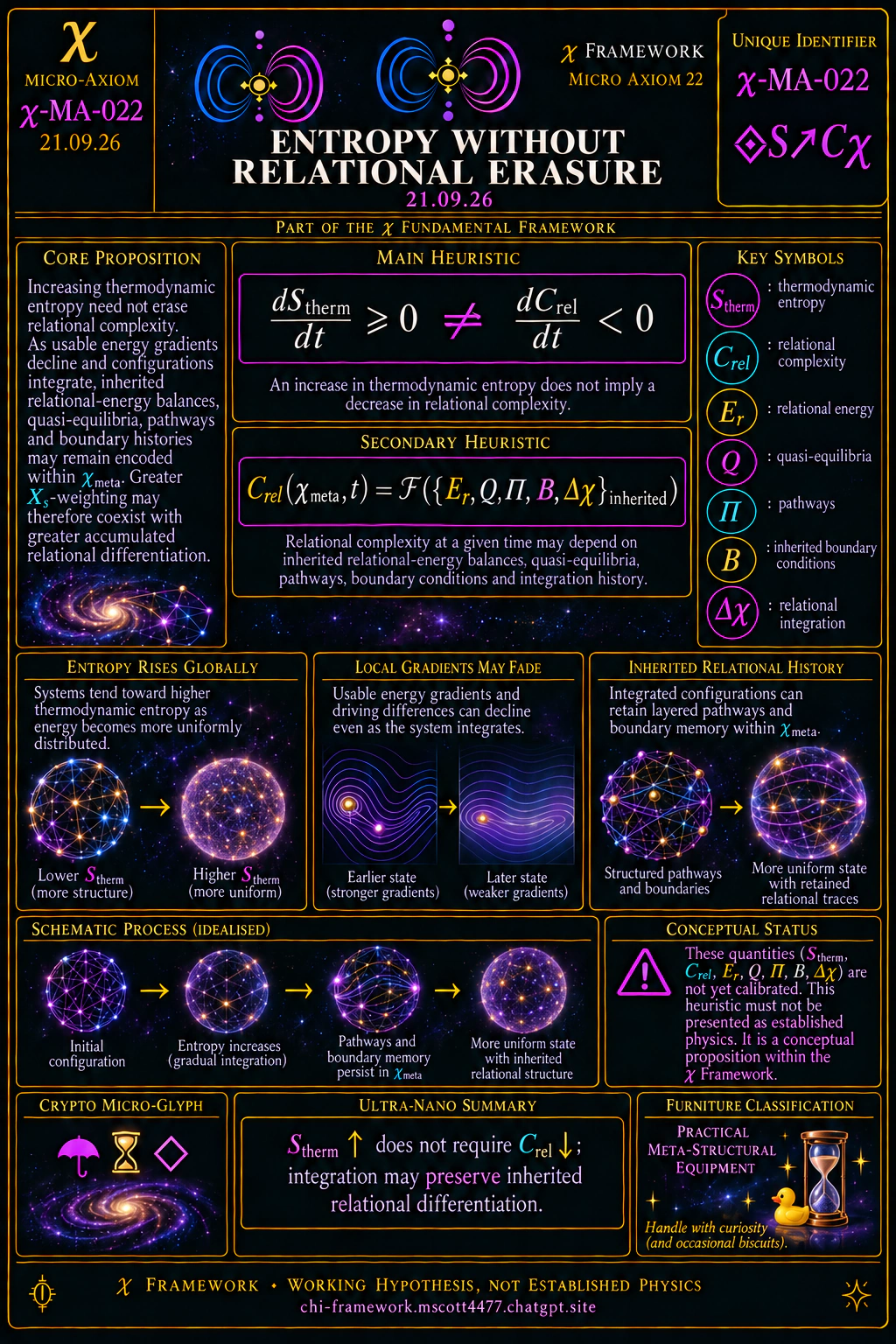
Increasing thermodynamic entropy need not imply the loss of relational complexity. As usable energy gradients decline and configurations integrate, inherited relational-energy balances, quasi-equilibria, pathways and boundary histories may remain encoded within χ_meta. Greater Xs-weighting may therefore coexist with greater accumulated relational differentiation.
χ-MA-022 · ⟐S↗Cχ · ☂︎⌛◇Cryogenic alignment can invert across nested scales
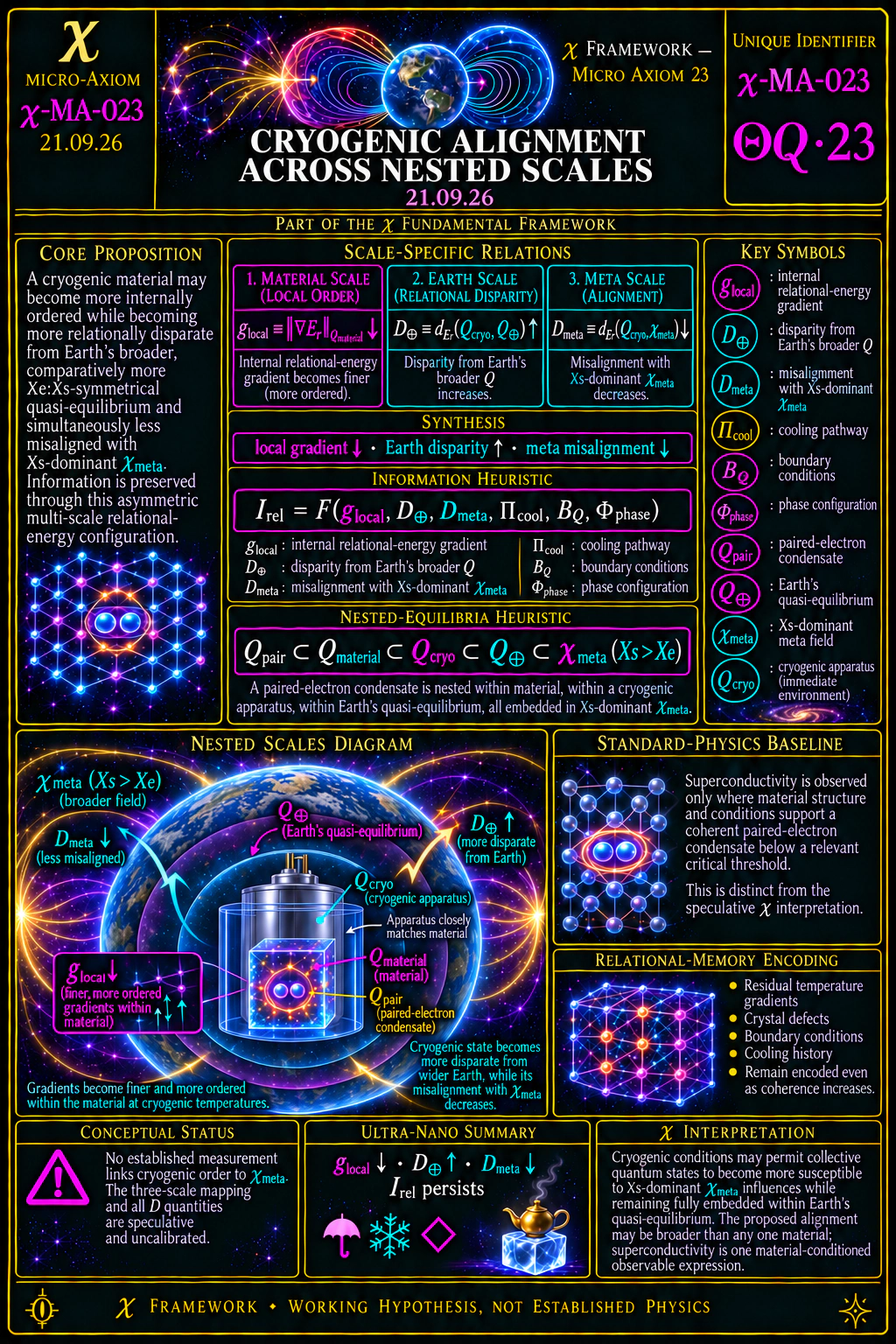
A cryogenic material may become more internally ordered while becoming more relationally disparate from Earth's broader, comparatively more Xe:Xs-symmetrical quasi-equilibrium and simultaneously less misaligned with Xs-dominant χ_meta. Information is preserved through this asymmetric multi-scale relational-energy configuration.
χ-MA-023 · ΘQ·23 · ☂︎❄︎◇Internal regularity does not set one boundary trend
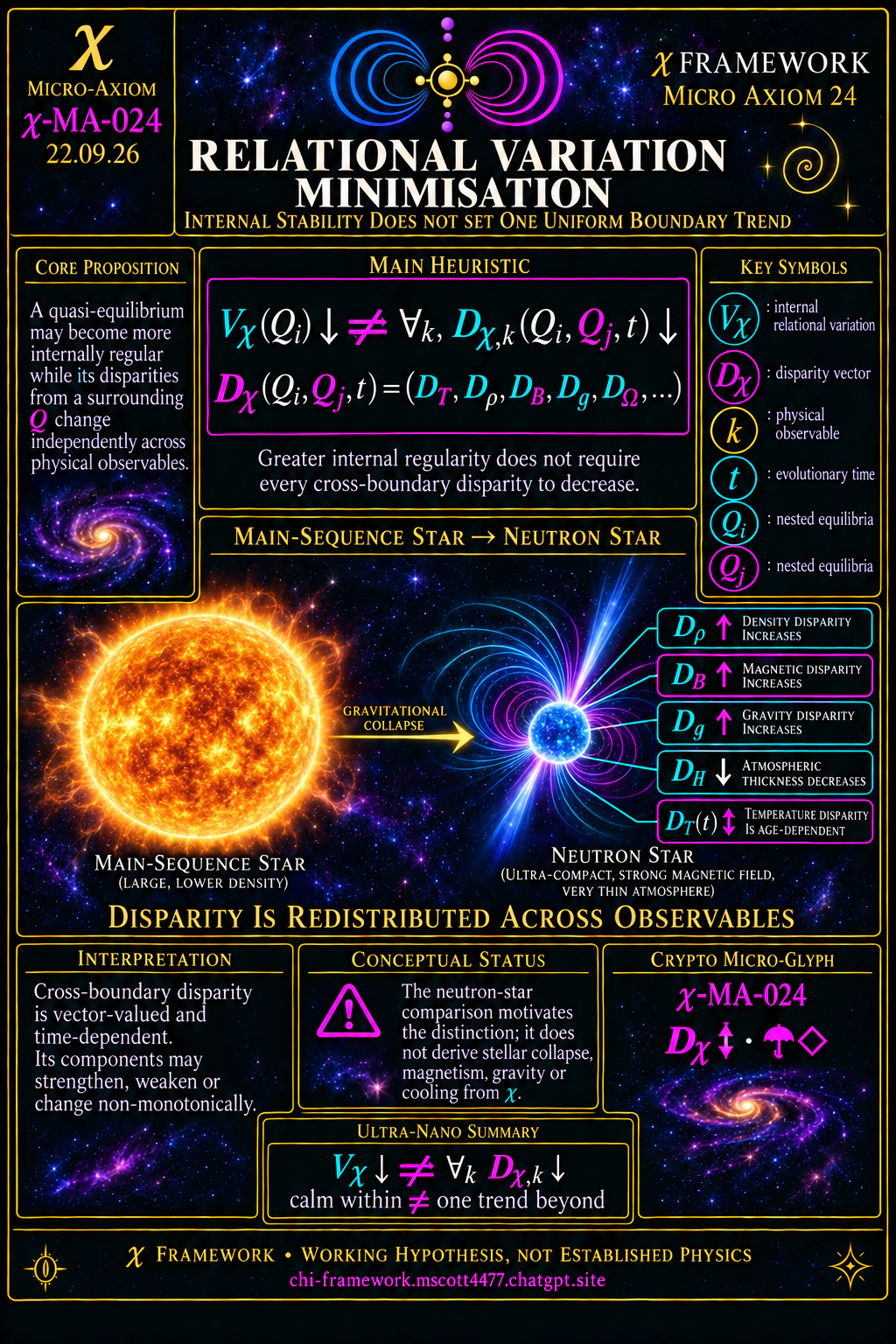
A quasi-equilibrium may become more internally uniform in its rχ weighting while its disparities from a surrounding Q change differently across physical observables. In the idealised transition from a main-sequence star to a neutron star, density, magnetic-field and surface-gravity contrasts may increase, atmospheric thickness decreases, and thermal contrast remains strongly dependent on age and evolutionary history.
χ-MA-024 · 𝐃χ↕ · ☂︎◇One primordial disparity bound can permit many spectral outcomes
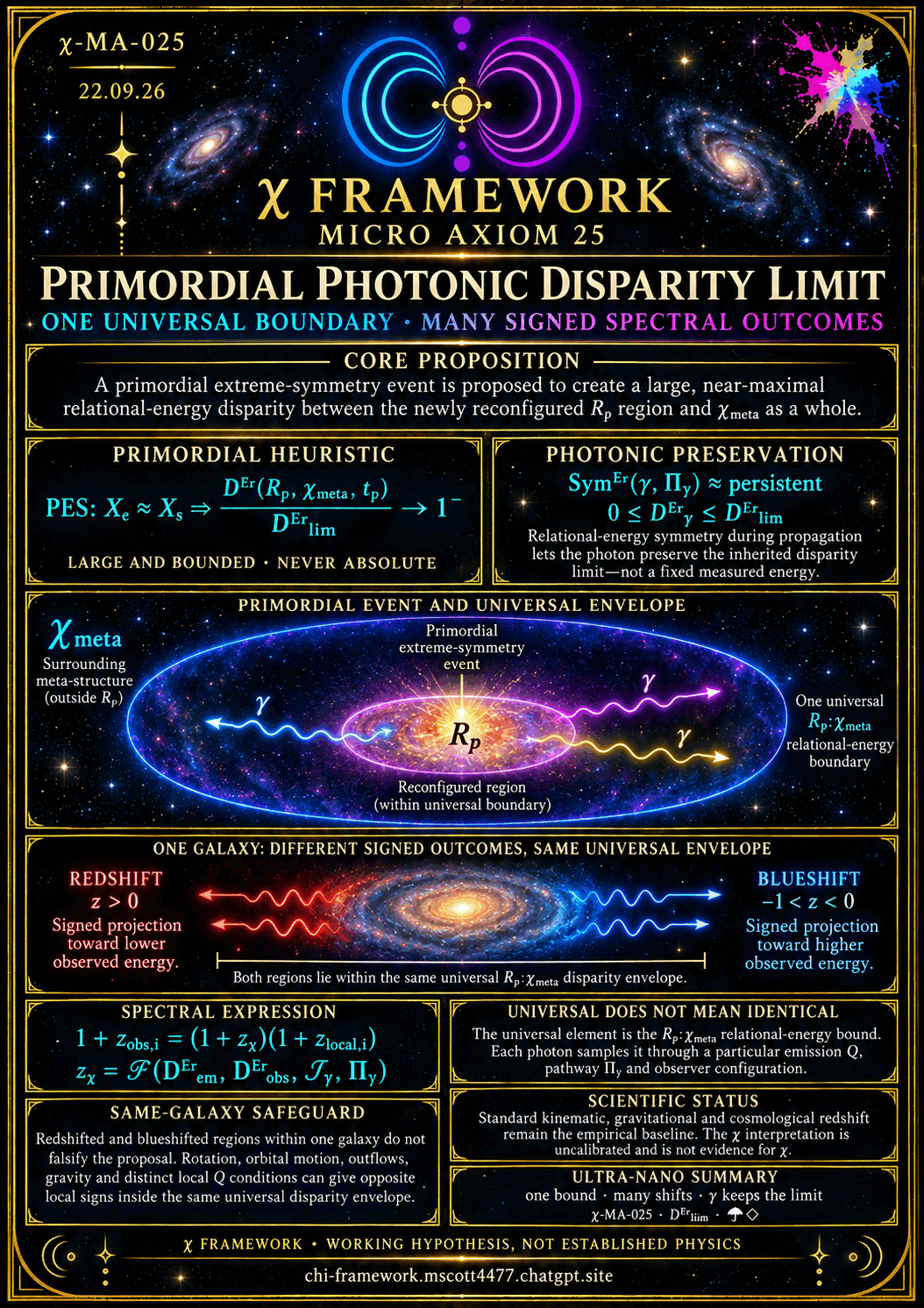
A primordial extreme-symmetry event is proposed to establish a large, near-maximal but non-absolute relational-energy disparity between the newly reconfigured Rₚ region and χ_meta as a whole. Photons preserve this inherited disparity constraint through relational-energy symmetry during propagation, while their measured redshifts and blueshifts remain signed outcomes conditioned by particular emission quasi-equilibria, pathways and observation contexts.
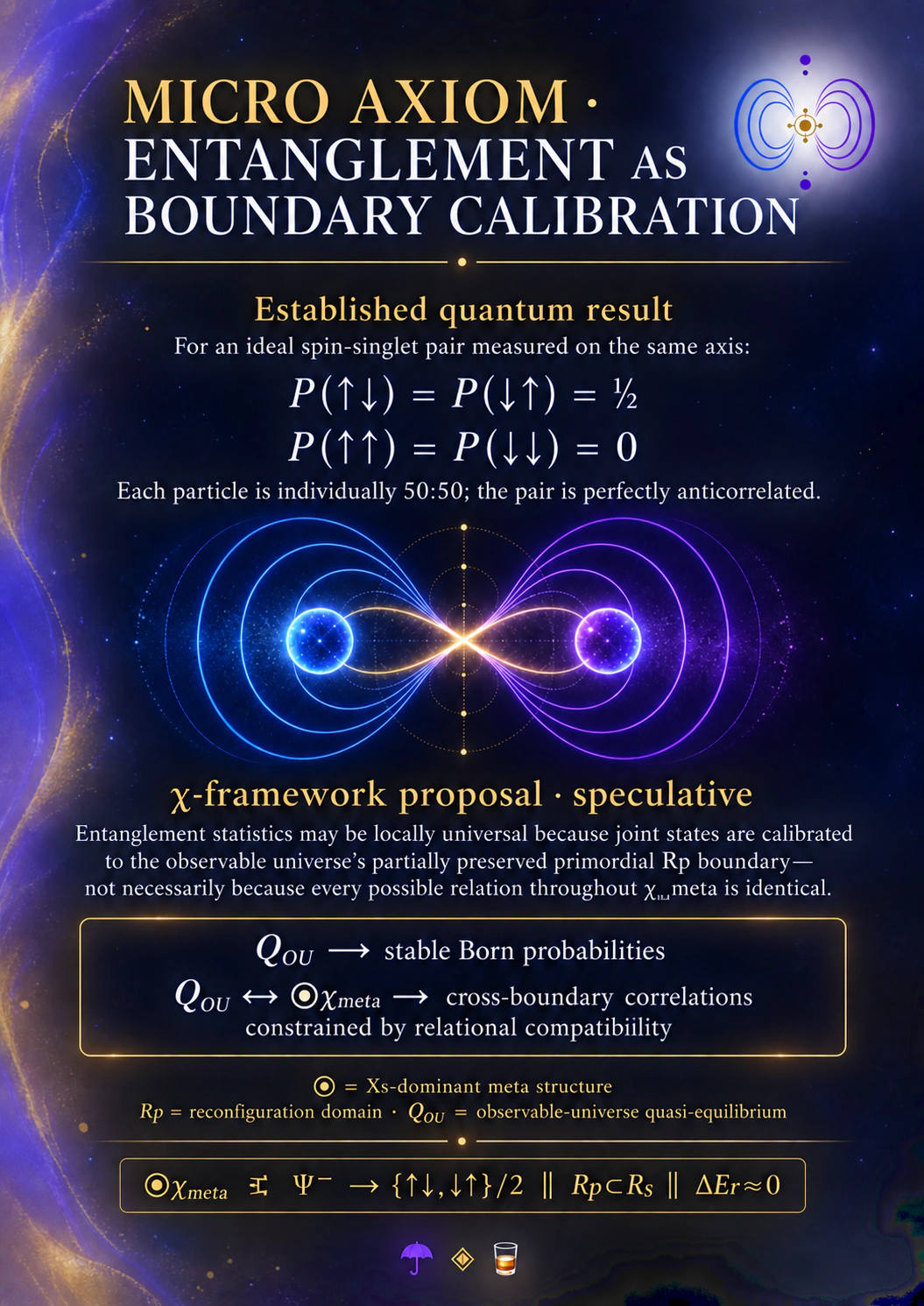
χ-MA-025 · Dᴱʳlim · ☂◇Stable entanglement statistics may reflect inherited boundary calibration
For an ideal spin-singlet pair measured along the same axis, standard quantum mechanics predicts individually 50:50 outcomes and perfect anticorrelation: the two allowed joint outcomes each occur with probability one half. The χ Framework provisionally interprets the stability of those Born probabilities within the observable universe as calibration to its partially preserved primordial Rₚ boundary, while leaving possible relations beyond that boundary empirically open.
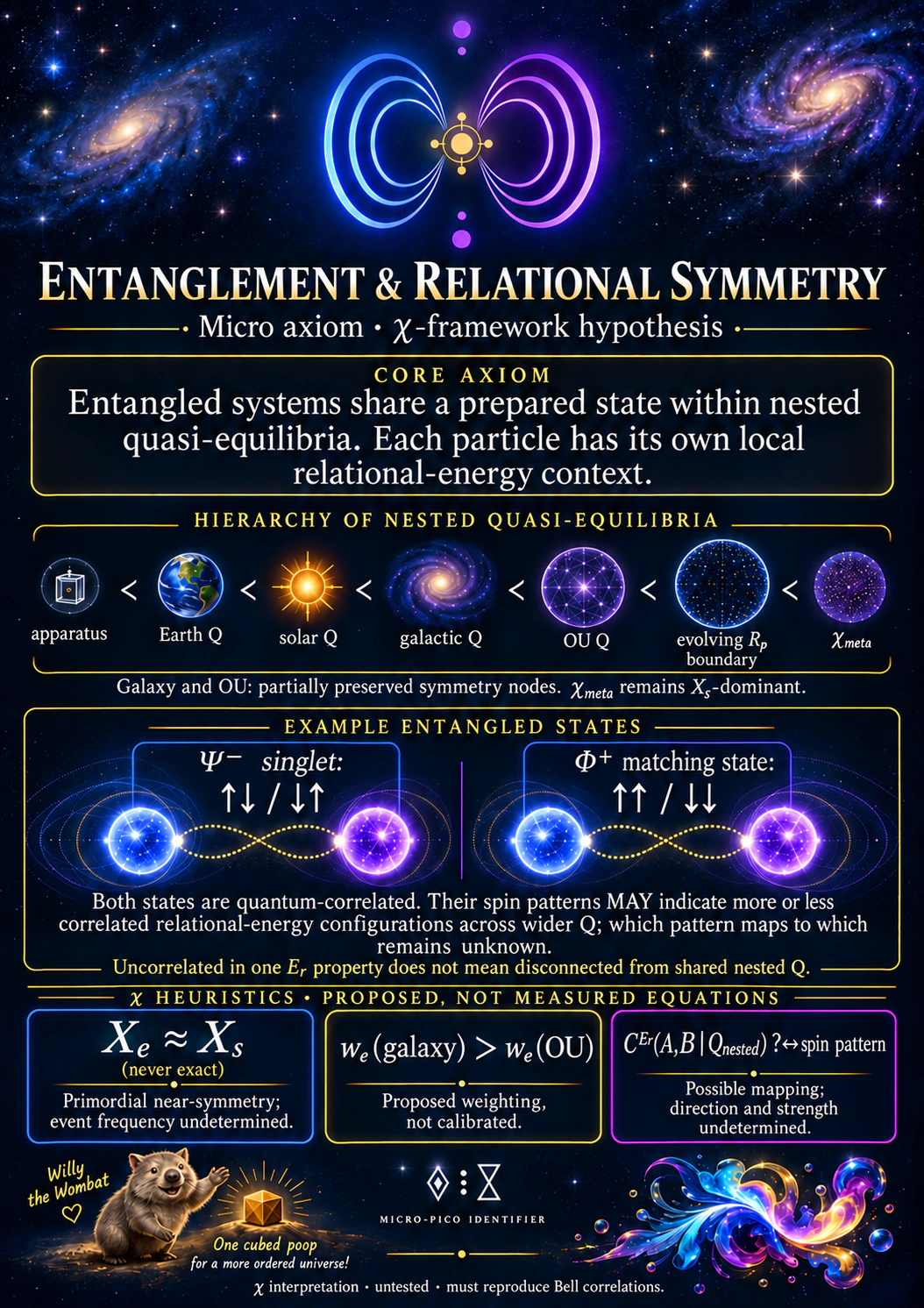
⟦χ·EPR–BC·09⟧ · ☂︎◈🥃Entangled states within nested relational-energy symmetry
The χ Framework proposes that entangled systems are prepared and measured within nested quasi-equilibria, including an apparatus, Earth, the Solar System, our galaxy and the observable universe for Earth-based experiments. The galaxy and observable universe are interpreted as partially preserved symmetry nodes descended from a primordial near-symmetry event (Xₑ≈Xₛ, never exact); the galactic node is proposed to retain a higher Xₑ weighting relative to Xₛ than the broader observable-universe node. The evolving Rₚ boundary carries that history within pre-existing, Xₛ-dominant χ_meta. Event frequency remains undetermined. Each particle retains its own local relational-energy context within this shared hierarchy. Spin-state combinations may indicate more correlated or uncorrelated relational-energy configurations in relation to wider Q, but which pattern corresponds to which degree of correlation remains unknown.
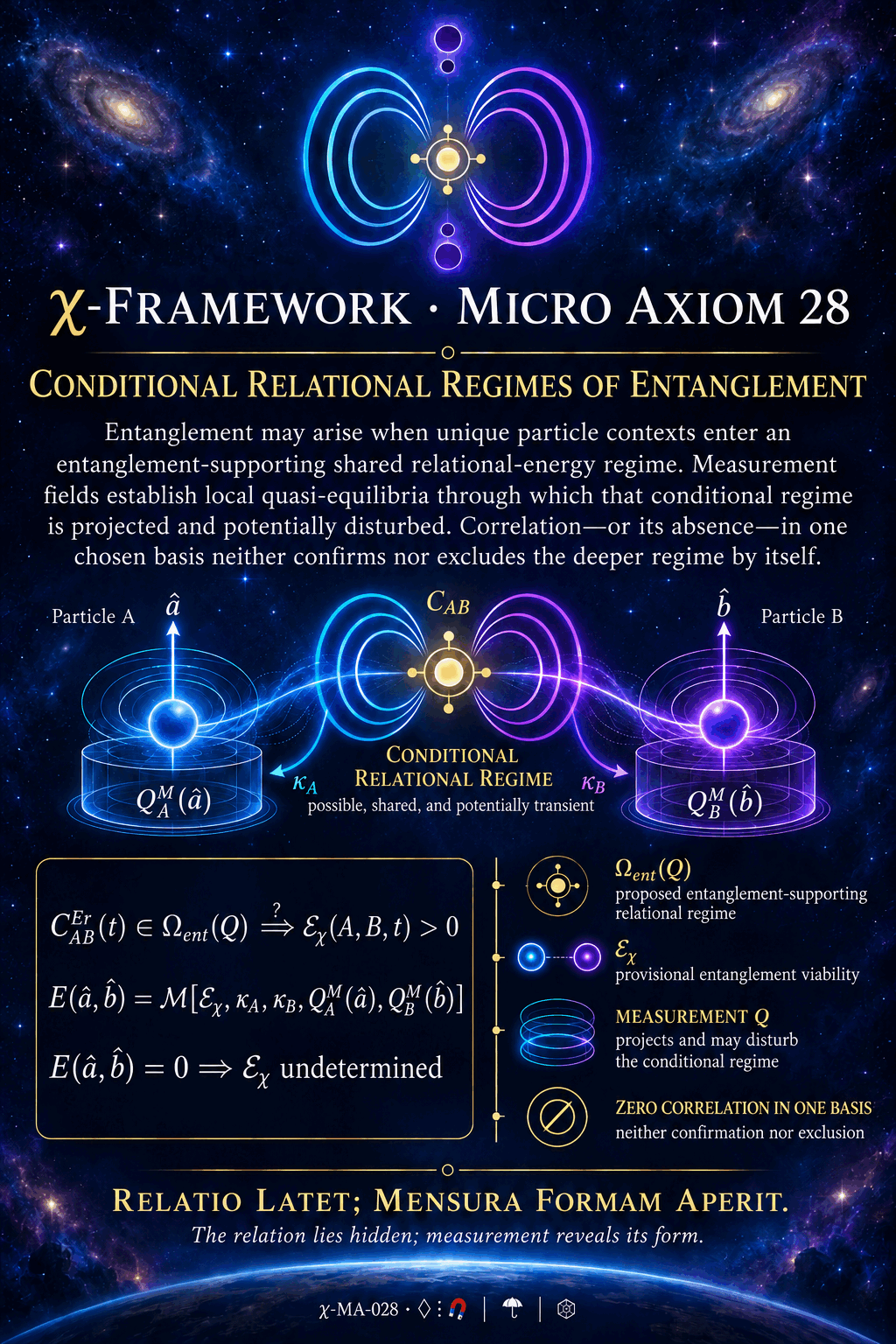
χ-MA-027 · ⟡⋮⧖ · 🐾▣Entanglement may occupy a conditional shared relational regime
Entanglement may arise when unique particle contexts enter an entanglement-supporting shared relational-energy regime. Measurement fields establish local quasi-equilibria through which that conditional regime is projected and potentially disturbed. Correlation—or its absence—in one chosen basis neither confirms nor excludes the deeper regime by itself.
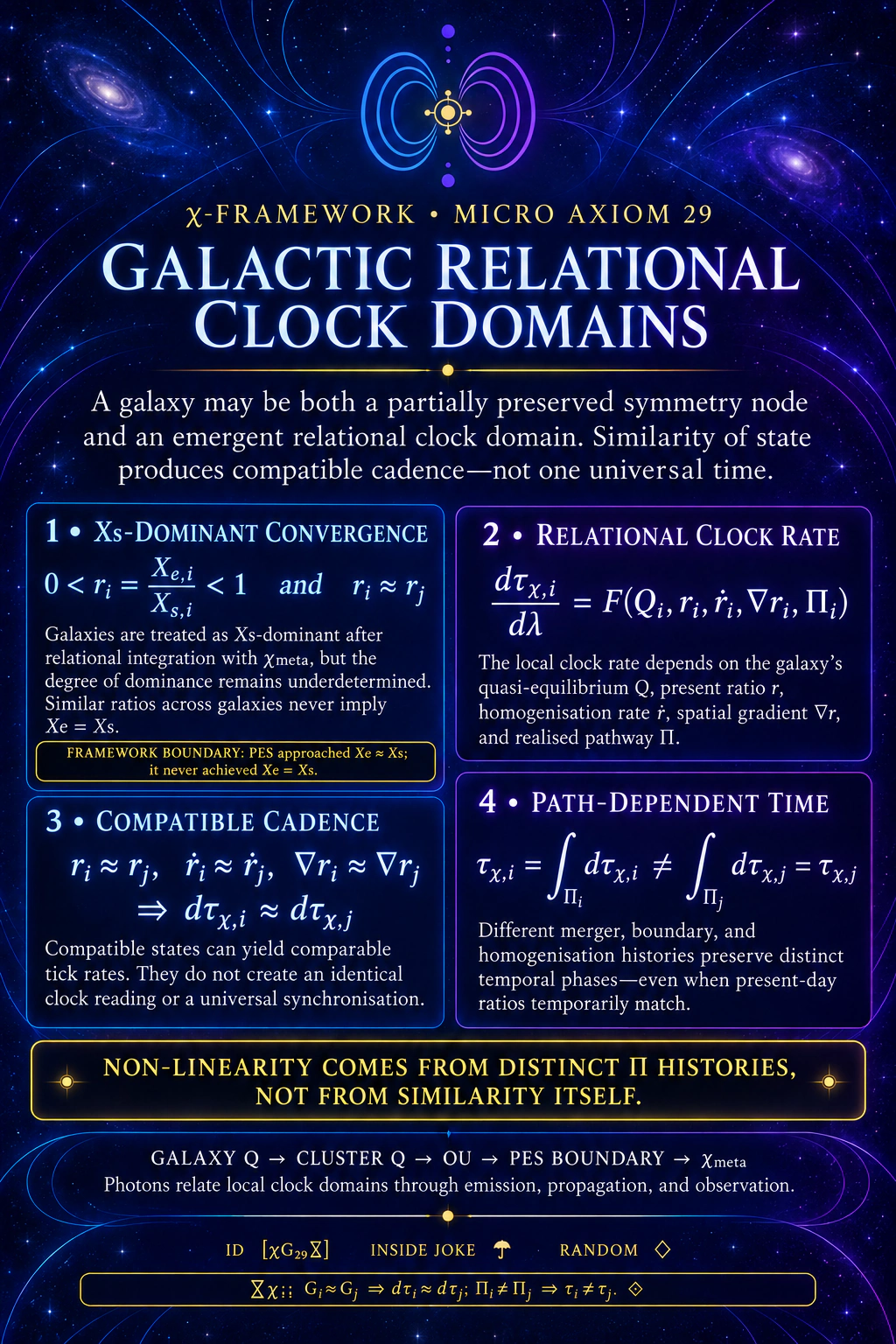
χ-MA-028 · ⟐⋮🧲 · ☂︎ · ⌬Galaxies may form compatible relational clock domains
A galaxy is provisionally treated as both a partially preserved symmetry node and an emergent relational clock domain. After relational integration with Xs-dominant χ_meta, a galaxy is assumed to remain Xs-dominant, although the degree of that dominance is presently underdetermined. Galaxies with similar Xe:Xs states, gradients and homogenisation rates may therefore exhibit compatible relational cadence without sharing one universal time or identical accumulated temporal phase.
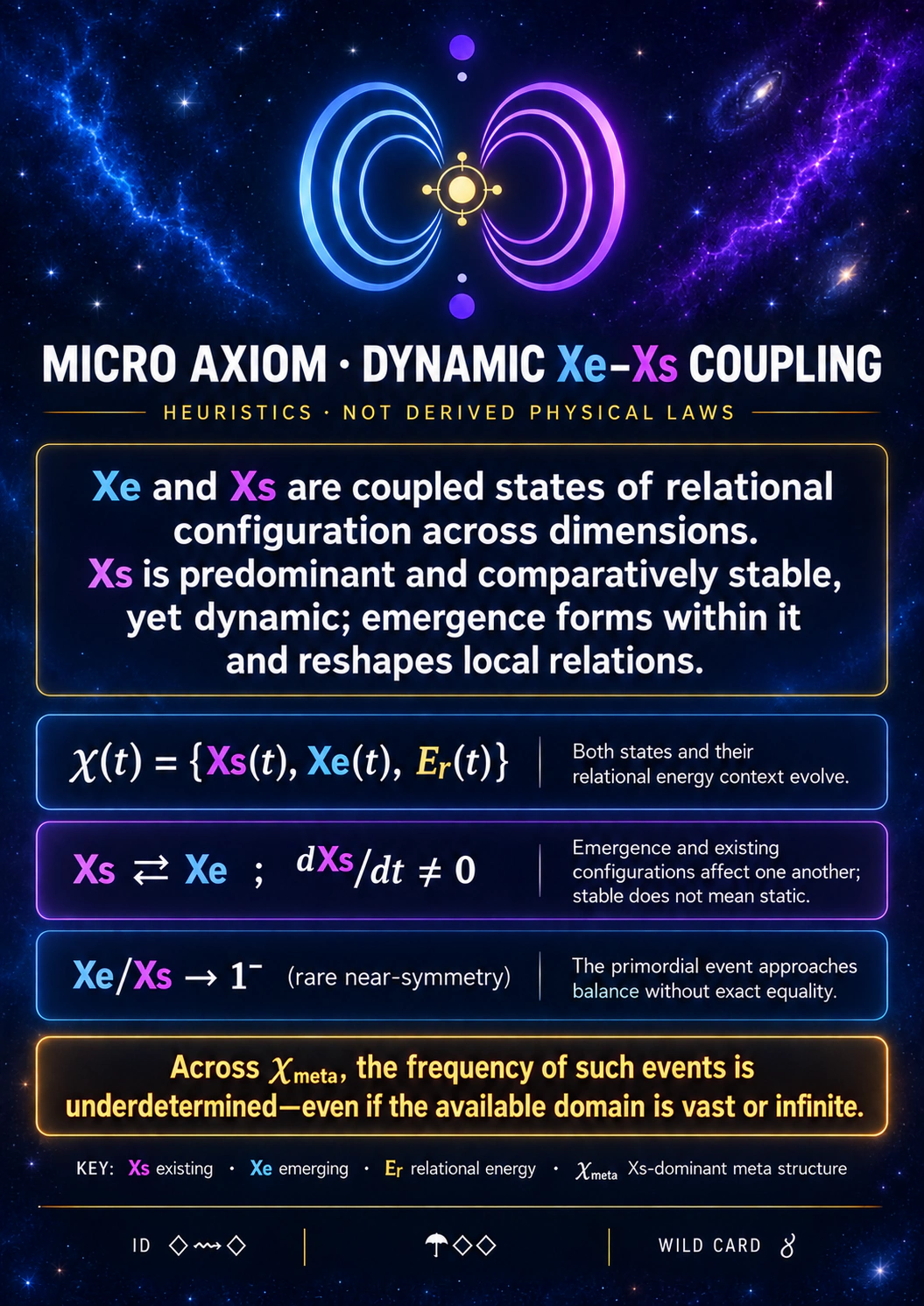
⟦χG₂₉⧖⟧ · ☂︎ · ⟡Xe and Xs may be coupled states across dimensions
Xe and Xs are proposed as emerging and existing states of relational configuration across dimensions, rather than two separate dimensions or fixed reservoirs. Xs is the predominant, comparatively stable configuration of the pre-existing χ_meta, but can remain dynamic and complex. Emergence develops within that context and may reshape its local relations. A rare primordial event may approach Xe≈Xs without achieving exact equality; how often such contexts arise across χ_meta remains undetermined, even if its domain is vast or infinite.
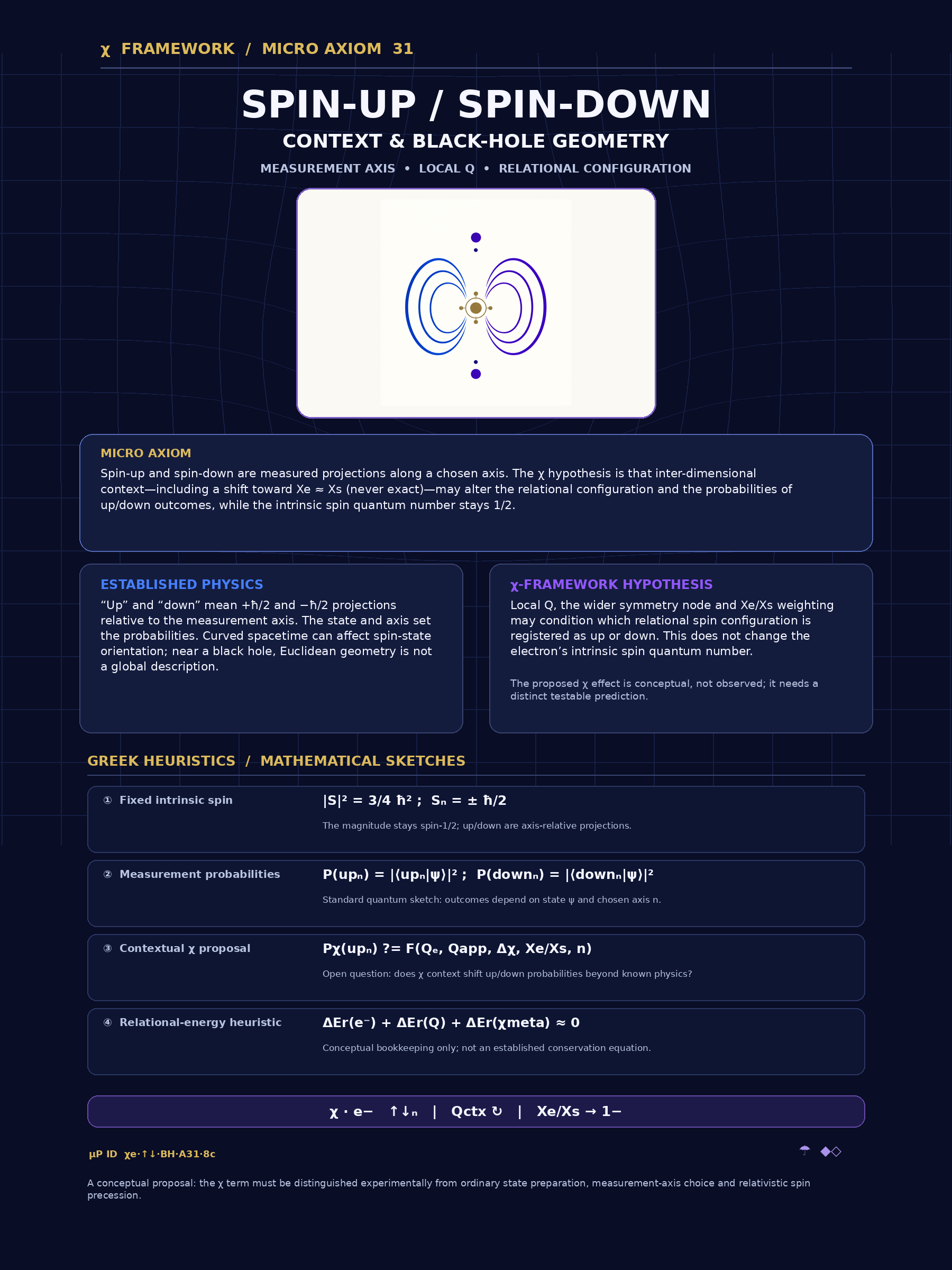
χ-MA-030 · ⟐↭⟐ · ☂◇◇ · ⌁Spin-up and spin-down outcomes may depend on context
Spin-up and spin-down are measurement projections along a chosen axis, not changes to an electron’s intrinsic spin quantum number. Standard quantum mechanics assigns their probabilities from the electron’s state and the measurement axis; curved spacetime can also affect spin-state orientation. The χ framework hypothesises that inter-dimensional context—including a shift toward Xe≈Xs (never exact)—may alter the relational configuration and the probabilities of up/down outcomes across the local Q and wider symmetry node.
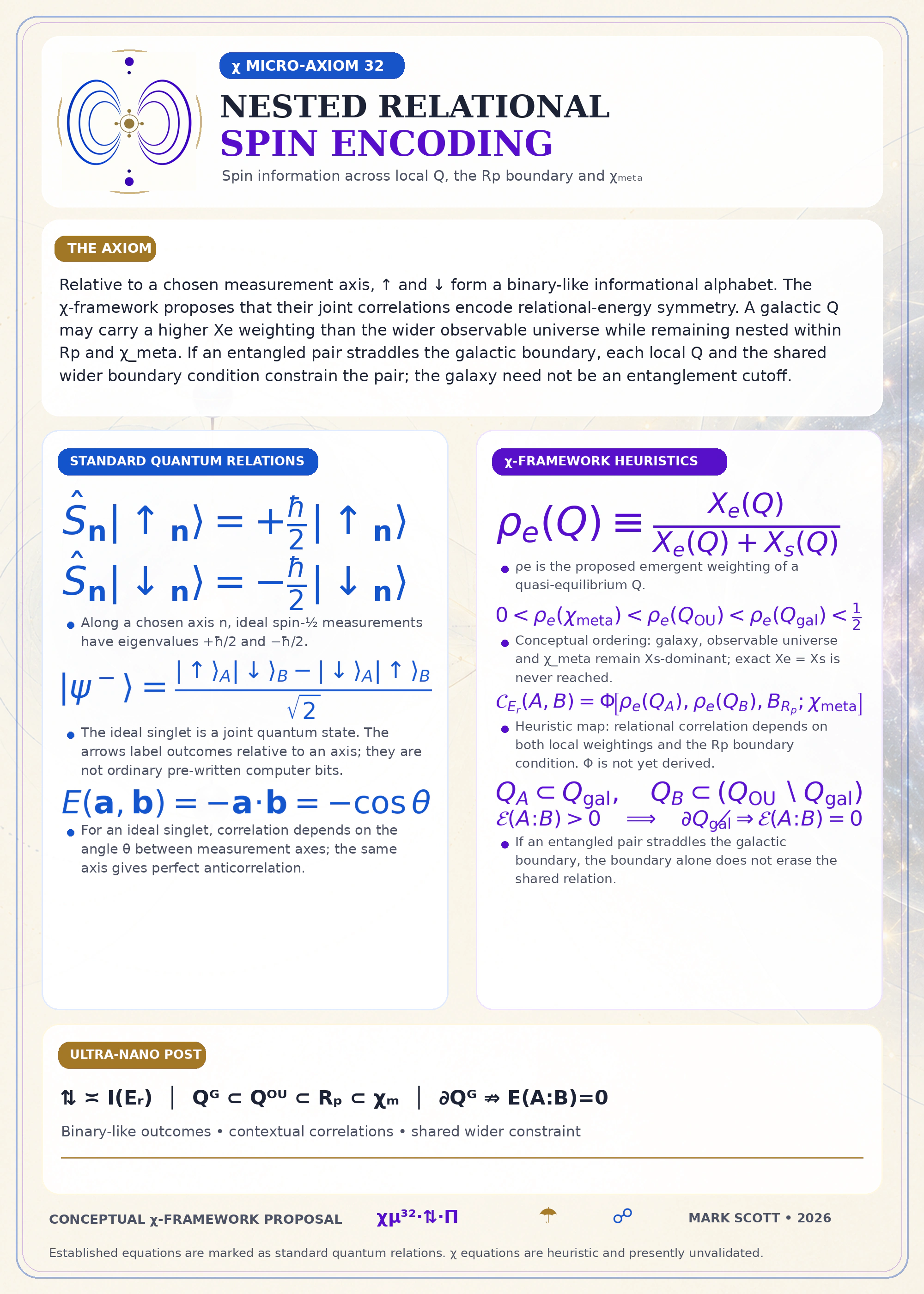
χ-MA-031 · ⟲e⁻ · ☂︎◇Spin information may remain correlated across nested boundaries
Relative to a chosen measurement axis, spin-up and spin-down form a binary-like informational alphabet. The χ Framework proposes that their joint correlations encode relational-energy symmetry. A galactic quasi-equilibrium may carry a higher Xe weighting than the wider observable universe while remaining nested within Rₚ and χ_meta. If an entangled pair straddled the galactic boundary, each local Q and the shared wider boundary condition would constrain the pair; the galaxy need not be a fundamental entanglement cutoff.
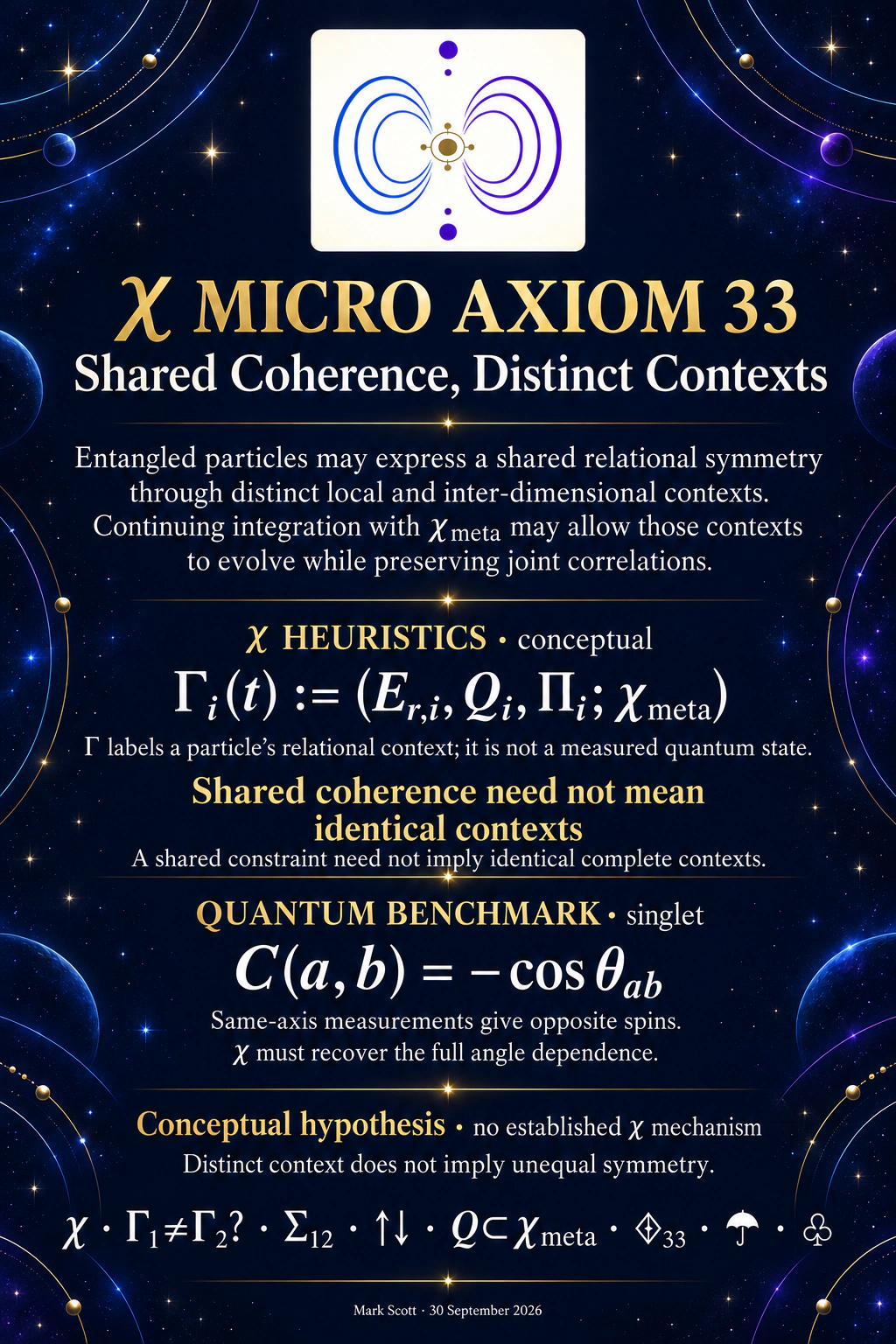
χμ³²·⇅·Π · ☂︎ · ☍Shared coherence need not require identical particle contexts
Entangled particles may express a shared relational symmetry through distinct local and inter-dimensional contexts. Continuing integration with χ_meta may allow those contexts to evolve while preserving joint correlations. Coherence is proposed at the level of the pair’s joint relational configuration; neither identical complete contexts nor unequal symmetry is required.
χ-MA-033 · ⟡₃₃ · ☂ · ♧Addendum to 33 · From shared coherence to photon continuity
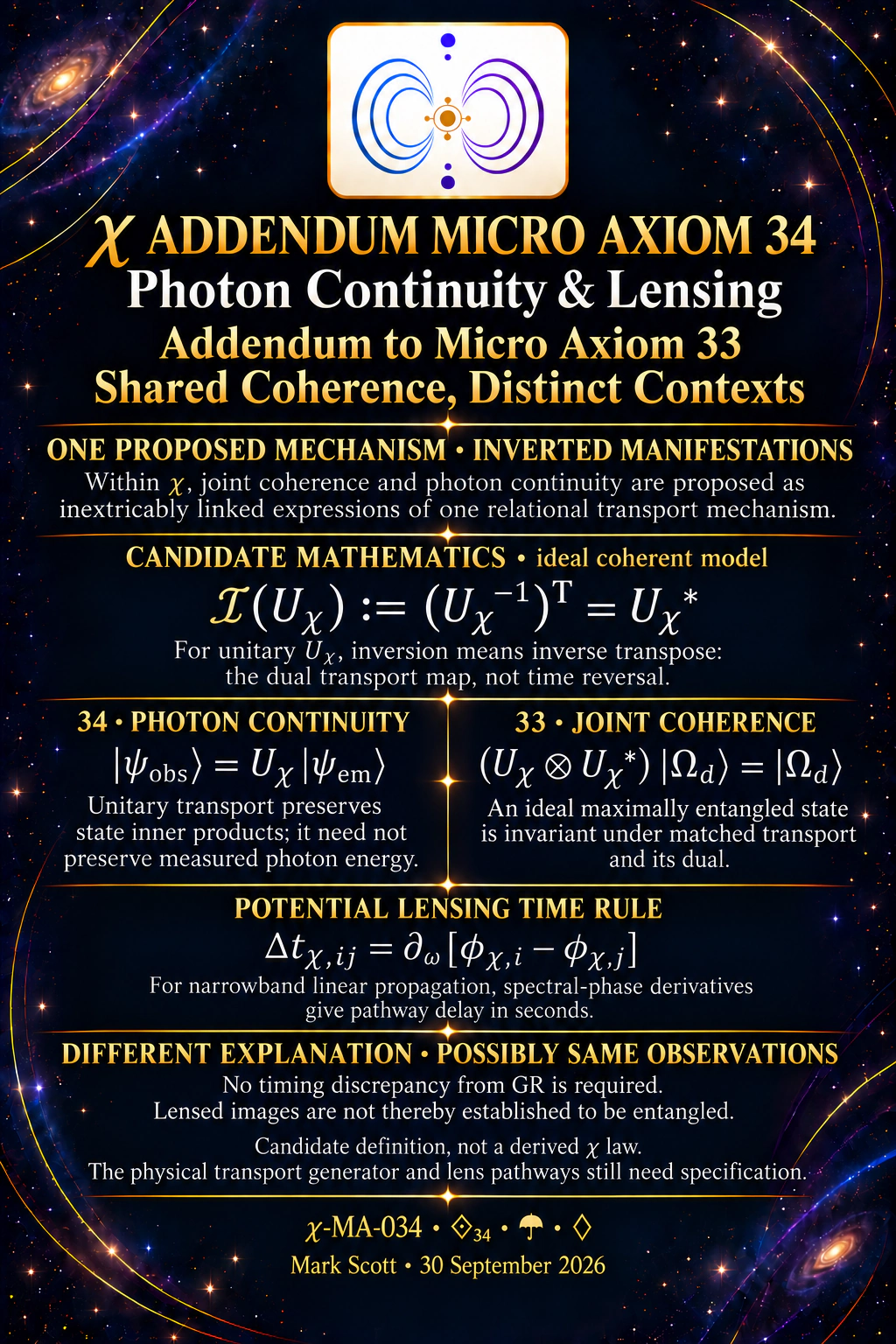
Micro Axiom 34 extends Micro Axiom 33, Shared Coherence, Distinct Contexts. Axiom 33 proposes that an entangled pair’s shared joint relational symmetry may coexist with distinct local particle contexts. This addendum applies the same conceptual principle to an inherited photon-emission constraint persisting through distinct, evolving pathways and lensing contexts within nested Q and χ_meta. Within χ, the two are proposed to be inextricably linked, inverted manifestations of one underlying relational mechanism. This is a common-mechanism hypothesis, not an analogy alone. A candidate mathematical definition is dual transport, 𝓘(Uχ)=(Uχ⁻¹)ᵀ, reducing to complex conjugation for unitary Uχ. This ideal construction does not establish entanglement among lensed images or derive a physical χ mechanism.
χ-MA-034 · ⟡₃₄ · ☂ · ♢The exact relational configuration of Rs is underdetermined
Rₛ is a provisional stability label within the χ-framework. Its exact relational configuration—and whether it is distinct from Rₚ or the broader Xₛ-dominant χ_meta—remains underdetermined. Possible comparisons are tentative: Rₛ could have greater Xₑ weighting than χ_meta but less than Rₚ/the observable-universe domain; fewer nested symmetry nodes than Rₚ/OU but perhaps more than the broader χ_meta; and a higher vacuum-fluctuation frequency than χ_meta, perhaps even than Rₚ/OU.
χ-MA-035 · ◇•χ∂₃₅ · ☂ · ☄Global integration may coexist with buffered local gravitational memory
An intense Rₚ reconfiguration may suppress the independent gravitational expression of emerging nested quasi-equilibria without erasing them. As Rₚ homogenises with Xₛ-dominant χ_meta, the framework provisionally allows the Rₚ-wide effective gravitational relation to weaken while long-lived bound Q retain partially inherited local calibration.
⟦χ³⁶·Ḡᴿᵖ·Qᵇ⟧ₘₚ · ⌁🥫⁰·❄︎⌁ · ⌬Propagation can share a relational field without sharing one transport rule
The observable universe is compared metaphorically to a vast relational transport network. Photons may preserve an emission-encoded χ configuration while their observed energy reflects emission-to-observation disparity. Neutrinos, which interact very weakly with matter, can travel great distances while their detected flavour projection changes. In the χ proposal, a source Q supplies initial calibration and the pathway contributes accumulated relational change. This does not make the universe a literal conductor or imply exact Xe = Xs at emission.
χ-MA-037 · ⟡ν₃₇ · ☂︎🐾Information richness may track relational-energy differentiation
Informational richness may be related to relational-energy differentiation: differentiated configurations could make more relational distinctions available, while broader context may also shape the pattern. The framework does not establish the direction, strength or mechanism of this link. Neither independence nor equivalence follows from the definitions alone.
χ-MA-038 · IΔE · ◇Informational richness may develop through inherited accessibility
Micro Axiom 39 proposes that present informational richness is historically conditioned by pre-existing relational-energy configurations within χ_meta. Those configurations may supply inherited structure, latent pathways and susceptibility to a near-extreme Xe≈Xs event. An Rp reconfiguration can then alter which Π become accessible and which nested Q become expressible, without creating information from nothing.
χ-MA-039 · ⟐χ39⟡ · 🥃⋄⋄Near-symmetry may set a photon's velocity at emission
The χ Framework proposes that a photon is emitted already travelling at the local vacuum speed c: it does not accelerate toward that velocity. Near-perfect relational-energy symmetry, considered relative to the observable-universe Rₚ domain and χ_meta, is proposed as the condition associated with this immediate propagation. Across the vast Rₚ region, that local propagation condition may remain near-symmetric while emission-to-observation relational-energy disparity appears as redshift. The redshift describes a change in measured photon energy and frequency; it does not by itself show that the local speed changed or that symmetry was absolute.
⟦χμ⁴⁰·c·Πγ⟧ · ☂︎⋈🥃 · ⌬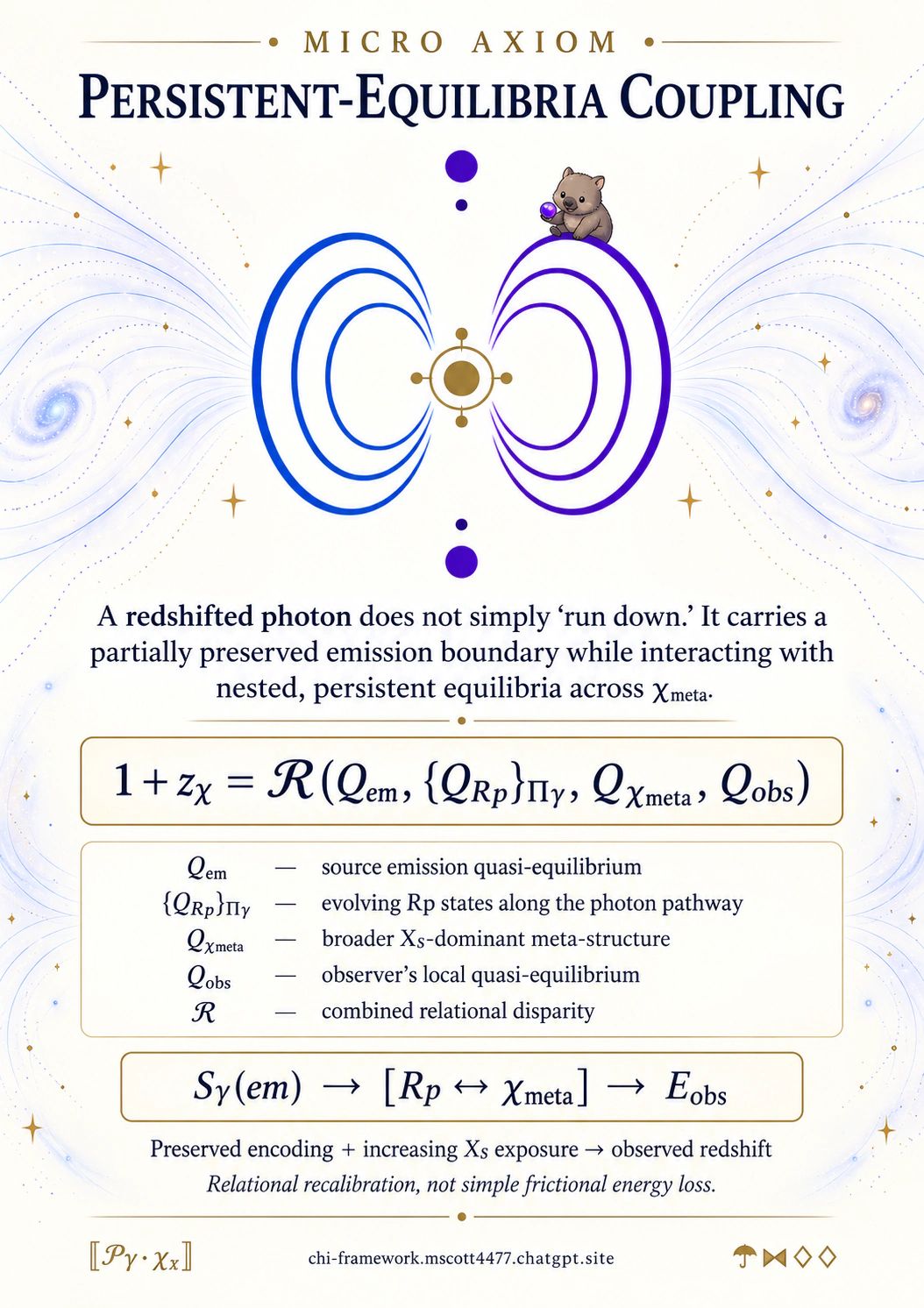
34 · Different explanations may give the same observations
Addendum to Micro Axiom 33: Shared Coherence, Distinct Contexts. In 33, the proposed relation is joint symmetry across an entangled pair’s distinct contexts. In 34, the proposed relation is continuity of an emission constraint across photon propagation contexts. The χ proposal treats these as inextricably linked, inverted manifestations of one underlying relational mechanism. Preservation of a relational constraint need not require identical complete contexts. This stronger claim remains unestablished; it does not itself imply entanglement among lensed images.
The χ Framework proposes that inherited photonic relational continuity, evolving nested quasi-equilibria and integration with χ_meta provide a different physical account of time delay and image multiplicity. This proposal does not require any difference between observed delays and GR’s predictions. χ may reproduce the same delays, image positions and multiplicity while proposing a different underlying cause.
One proposed mechanism, inverted manifestations
Entanglement is described here through joint relational coherence across distinct particle contexts; photon continuity through persistence of an inherited emission constraint across evolving propagation and lensing contexts. χ proposes that these are inverted expressions of the same underlying relational process, rather than merely comparable patterns. Neither expression is reduced to an identical observational effect.
Candidate inversion: transport and its dual
Assume an invertible transport map on a finite-dimensional complex state space with a specified basis. ᵀ denotes transpose, † Hermitian adjoint, and * entrywise complex conjugation. In this candidate definition, inversion means inverse transpose: transport in the dual representation. Applying it twice recovers the original map. It is not a claim of time reversal, negative energy or opposite spin. For unitary transport, the inverse transpose equals complex conjugation. This supplies a precise possible meaning of inversion, not a uniquely required interpretation of the framework.
Photon continuity: preserve a state relation
In an ideal coherent channel, unitary transport preserves inner products between states. χ provisionally identifies that preserved state-space relation with a possible expression of inherited Σγ. This identification requires a physical map from Eᵣ and nested Q to the state variables. Unitarity alone does not conserve measured photon energy between observers, specify redshift or guarantee preservation in a noisy or absorbing channel. Polarization states may provide one two-dimensional realisation; they do not make a photon a spin-½ particle.
Entanglement: preserve a joint constraint with dual transport
For an invertible Uχ this follows using row-vectorisation: (Uχ⊗V)vec(I)=vec(UχVᵀ), which equals vec(I) when V=(Uχ⁻¹)ᵀ. Requiring unitarity makes both maps deterministic norm-preserving transports; then V=Uχ*. This ideal maximally entangled pair remains invariant under matched transport and its dual even though local contexts are labelled separately. It does not say that arbitrary local histories automatically produce matched maps. General independent local unitaries preserve the amount of entanglement but may change the joint state and its fixed-axis correlations; noisy channels need a separate treatment.
The canonical two-level Ω₂ is the Φ⁺ Bell state, not the spin singlet. A singlet is locally equivalent through a specified basis transformation; its familiar invariance is under matched U⊗U for SU(2), with correlations −a·b. One must transform states and observables consistently. These identities are established mathematics, not new χ predictions. The candidate common-mechanism claim is that photon transport and the paired dual response arise from one relational generator. Local U⊗U* does not generate entanglement from a separable input, so source preparation remains a separate requirement.
A possible generator and timing rule
𝒫 orders noncommuting generators along the path. ℓ is a chosen physical path-length coordinate and Kχ has units of inverse length, so the exponent is dimensionless. Hermiticity supplies unitarity. For the dual map, its local generator is −Kχᵀ in the same convention. This defines a family of possible models; no physical form or calibrated parameters for Kχ have been derived from χ. The construction needs a specified observer frame, mappings between the particle and photon state spaces, and a consistent treatment of redshift and evolving contexts. It is not yet a relativistic propagation theory.
For a specified nonzero source-to-detector channel amplitude, write ai as a nonnegative magnitude and φχ,i as its unwrapped phase. Use the Fourier convention E(t)=∫E(ω)e⁻ⁱωt dω and a common observer angular frequency ω. In narrowband linear propagation with slowly varying amplitude and phase curvature, the phase derivative gives group delay in seconds. It is not photon proper time. Differential phases remove a common time-origin offset; no residual relative to GR is required. Strong pulse reshaping, broadband or time-dependent frequency-mixing channels require a fuller transfer-kernel calculation. The rule becomes predictive only after χ specifies the transfer phases independently of the measured delays.
Image multiplicity still requires χ to derive the allowed pathways and their amplitudes. A possible geometrical-optics starting condition is δΠφχ=0 for stationary-phase pathways, but the physical phase functional must be supplied; this condition alone does not predict the number or positions of images. The internal-state unitary does not determine lens magnification or image flux.
Multiplicity and source history
Multiple images are proposed to present a shared source history through distinct relational pathways. Their appearance does not by itself establish quantum entanglement between the images or distinguish χ from standard lensing. At one observing time, different delayed images can show different source epochs; comparisons must match the same emission episode. Preserved relational symmetry does not mean constant measured photon energy.
What could distinguish the explanations?
Specify the candidate Kχ from explicit relational assumptions, define Eᵣ, Σγ and Q operationally, derive the pathway-selection rules and map the phases to observer-clock seconds. The model must predict image positions, multiplicity, magnification and delays jointly. Its inputs and shared parameters must be specified independently of the observations it is asked to predict.
If both accounts predict the same observations within uncertainty, those observations cannot decide between their physical explanations. An empirical distinction requires an independently derived prediction where the accounts differ, potentially in another observable or regime. None is supplied here. Source variability, plasma, microlensing and measurement effects still need to be treated consistently in any observational test.
The proposed common mechanism and its inverted manifestations remain conceptual. Agreement with existing observations would be necessary but would not establish a unique mechanism or show that GR’s physical interpretation is incorrect. No complete χ propagation model or experimentally established replacement for GR is supplied by this axiom.
Mathematical background: Horodecki and Horodecki on U⊗U* invariant states. Timing background: RP Photonics Encyclopedia, “Group Delay”, Dr. Rüdiger Paschotta. These established results do not establish the proposed χ interpretation.
Established comparison background: Birrer and colleagues, Time-Delay Cosmography. This source describes standard lensing; it does not endorse the proposed χ account.
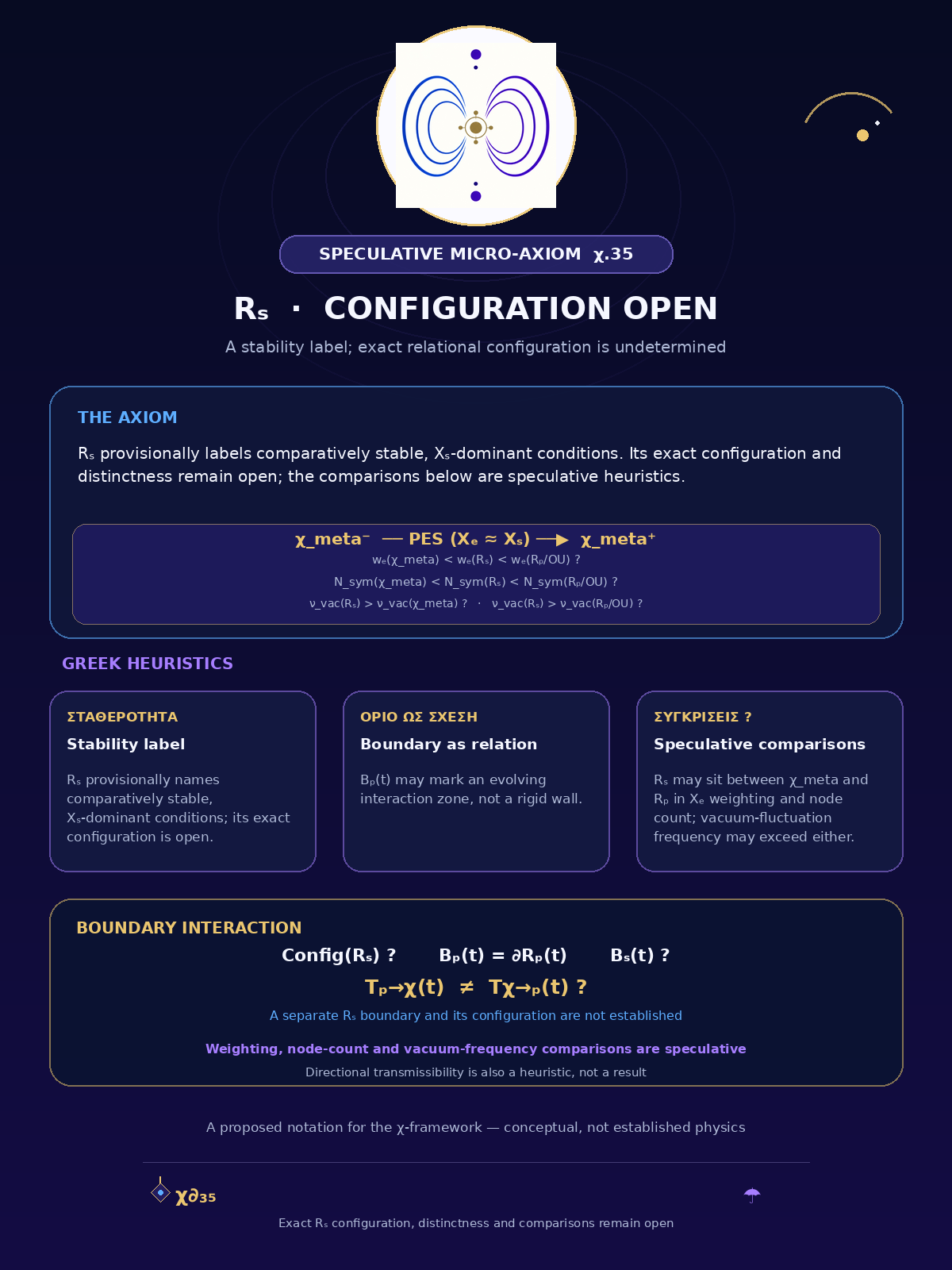
35 · Rₛ configuration remains underdetermined
Speculative refinement of the Rₚ/Rₛ description. Rₛ is a provisional label for comparatively stable, Xₛ-dominant conditions. Its exact relational configuration—and whether it is distinct from Rₚ or the broader χ_meta—is not specified. The primordial extreme-symmetry event is proposed to form Rₚ as a partially preserved reconfiguration domain and change inherited boundary conditions; its extent remains unspecified.
Boundary as an evolving interaction
Here χmeta− and χmeta+ label proposed pre-event and post-event relational conditions; they do not specify how much of the wider structure is reconfigured. Configχ(Rs) ? marks the exact Rₛ configuration as undefined, without asserting a separate containment relation. Bp(t) denotes a proposed evolving relational interface, not a rigid membrane.
𝒯 denotes proposed directional transmissibility across that interface. The inequality is a formal possibility, not an observation or derived law. The spatial extent and detailed effects of the primordial event remain underdetermined.
Speculative comparisons; configuration still open
These are possible orderings, not claims: Xₑ weighting could lie above χ_meta and below Rₚ/OU; node count could be lower than Rₚ/OU yet higher than the broader χ_meta. A proposed vacuum-fluctuation frequency might exceed the meta-structure value, perhaps even the Rₚ/OU value. Its definition and measurement are open. The exact Rₛ configuration, all comparisons and whether a distinct Rₛ boundary exists remain underdetermined.
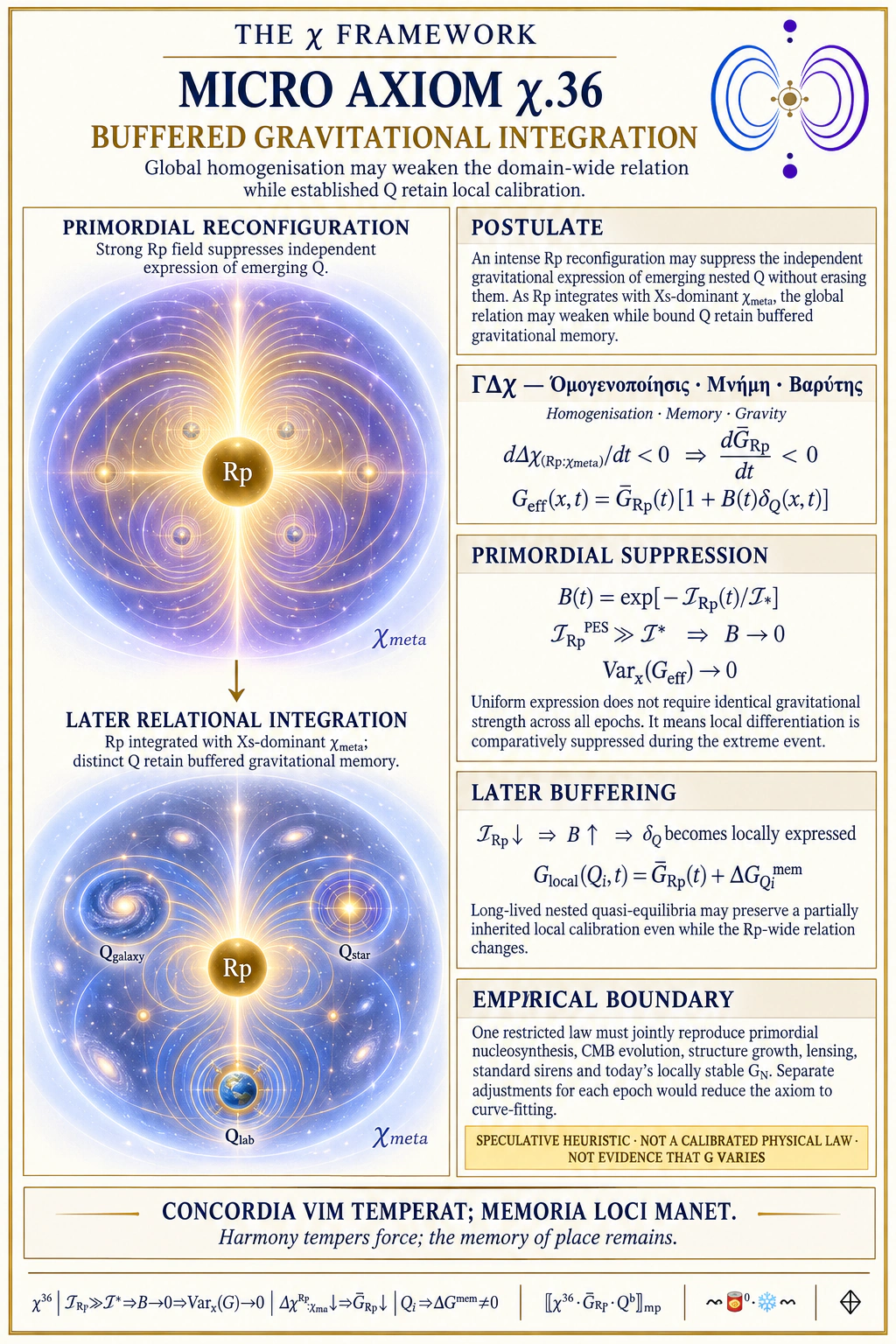
36 · Buffered Gravitational Integration
Speculative χ interpretation; not evidence that Newton's constant varies. An intense Rₚ reconfiguration may suppress the independent gravitational expression of emerging nested quasi-equilibria without erasing them. As Rₚ integrates with Xₛ-dominant χmeta, the Rₚ-wide effective relation may weaken while bound Q retain buffered gravitational memory.
ΓΔχ — Ὁμογενοποίησις · Μνήμη · Βαρύτης
Homogenisation · Memory · Gravity
Global integration
The first relation is a directional hypothesis: as the proposed disparity between Rₚ and χmeta decreases, the domain-wide effective gravitational relation ḠRₚ may also decrease. It does not define a numerical rate, identify ḠRₚ with the locally measured GN, or establish a varying constant.
One global term, one buffered local term
δQ represents the proposed local gravitational differentiation associated with nested quasi-equilibria. B controls how strongly it is expressed. 𝓘Rₚ is a provisional measure of reconfiguration intensity and 𝓘* a comparison scale; neither has an operational definition.
Primordial suppression, later local expression
During the proposed extreme-symmetry event, intense reconfiguration suppresses differences among emerging nested nodes, giving comparatively uniform gravitational expression. Uniformity here does not require identical gravitational strength across all cosmic epochs. As intensity falls, the same nested structures may become more independently expressed.
Buffered local memory
Long-lived Q may retain a partially inherited local calibration even while the Rₚ-wide relation changes. This memory term is a hypothesis, not permission to tune each environment separately. Concordia vim temperat; memoria loci manet. Harmony tempers force; the memory of place remains.
Empirical boundary
One restricted evolution law must jointly reproduce primordial nucleosynthesis, CMB evolution, structure growth, gravitational lensing, standard-siren distances and today's locally stable GN. Separate adjustments for each epoch would reduce the proposal to curve-fitting. Local, Solar-System and binary-pulsar bounds must also be respected.
Ultra-nano: χ³⁶│𝓘ᴿᵖ≫𝓘*⇒B→0⇒Varₓ(G)→0│Δχᴿᵖ:χₘ↓⇒Ḡᴿᵖ↓│Qᵢ⇒ΔGᵐᵉᵐ≠0
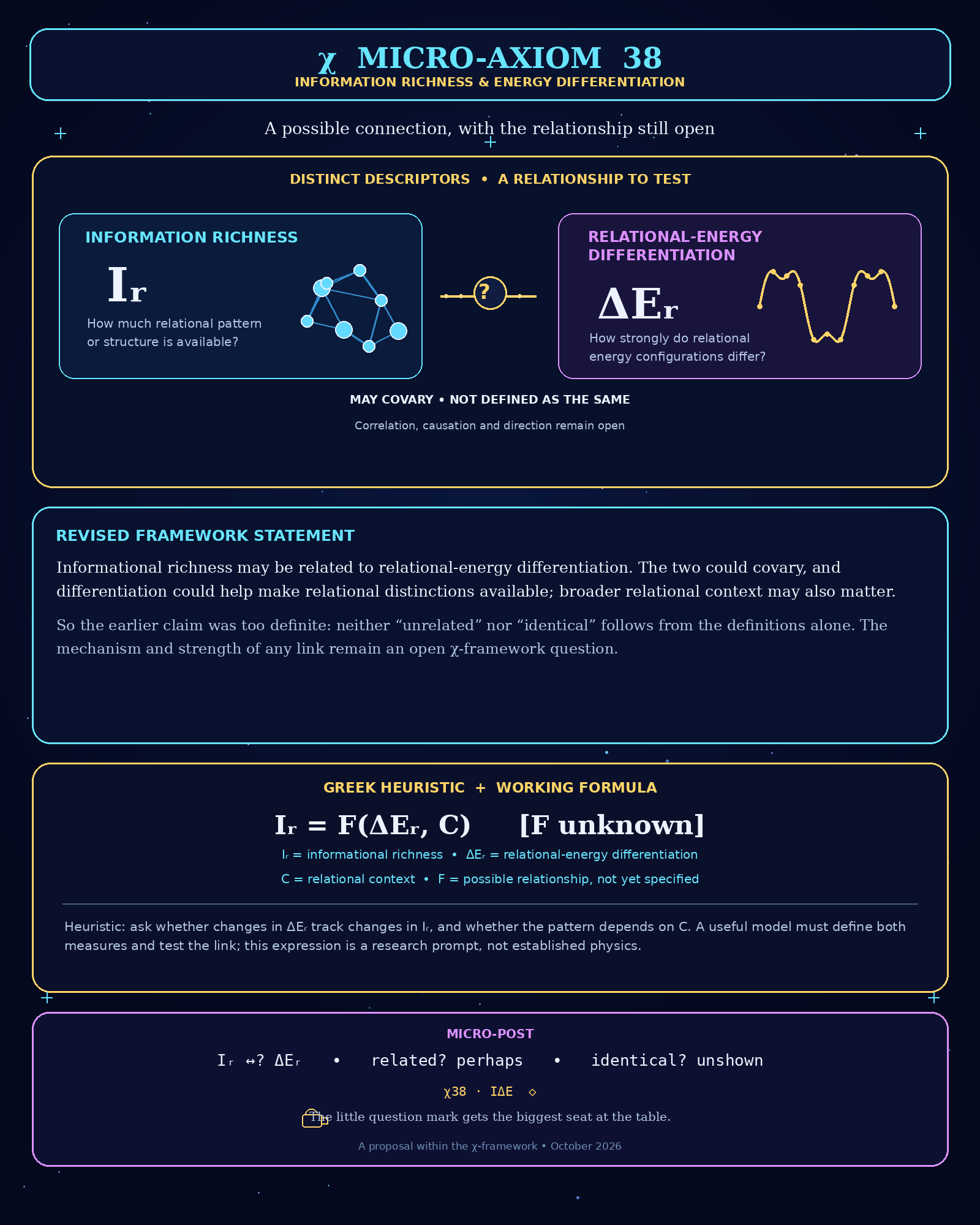
38 · Information Richness and Relational-Energy Differentiation
A proposed relationship, still open. Informational richness may track with relational-energy differentiation, perhaps because differentiated configurations make more relational distinctions available. The framework leaves room for a link without assuming that the concepts are identical or independent.
Iᵣ denotes informational richness; ΔEᵣ denotes relational-energy differentiation; C denotes relational context. F is an unspecified function. The proposal does not yet establish correlation, causation, direction or strength.
Ultra-nano: Iᵣ↔?ΔEᵣ · C matters? · relation open · Iᵣ≠ΔEᵣ by definition
39 · Inheritance–Accessibility
Provisional extension to Micro Axiom 38. Present informational richness may be a historically conditioned development of pre-existing relational-energy configurations within χmeta. Those configurations are proposed to supply inherited organisation, latent Π and the susceptibility through which perturbations can produce a near-extreme Xe≈Xs event and an Rp reconfiguration domain.
The event does not create all information from nothing. It reconfigures inherited relations, changing which pathways can become accessible, suppressed or recombined as new quasi-equilibria develop through accumulated Δχ.
Cpre denotes the proposed pre-event relational configuration. The expression expands Axiom 38's open function; it does not specify F, prove causation or make informational richness identical to relational-energy differentiation.
Energetic access condition
Energetic limits may constrain which pathways and stable configurations become locally expressible. They do not yet establish a fixed universal ceiling on informational richness throughout an infinite χmeta.
The inequality is a research heuristic, not a derived complexity law. It requires operational definitions for Iᵣ, accessibility, distinguishability, energy requirement and the relevant Rp boundary.
Ultra-nano: χ39 · Cpre↝Rp · Π↑Q↑ · ⟐

40 · Near-Symmetry and Instantaneous Photonic Velocity
Speculative χ interpretation. A photon is emitted already travelling at the local vacuum speed c; it does not accelerate toward that velocity. The χ proposal associates this immediate propagation with near-perfect relational-energy symmetry in relation to the observable-universe Rp domain and χmeta. The condition is proposed to remain near-symmetric locally across vast Rp distances while relational disparity between emission and observation appears in the measured redshift.
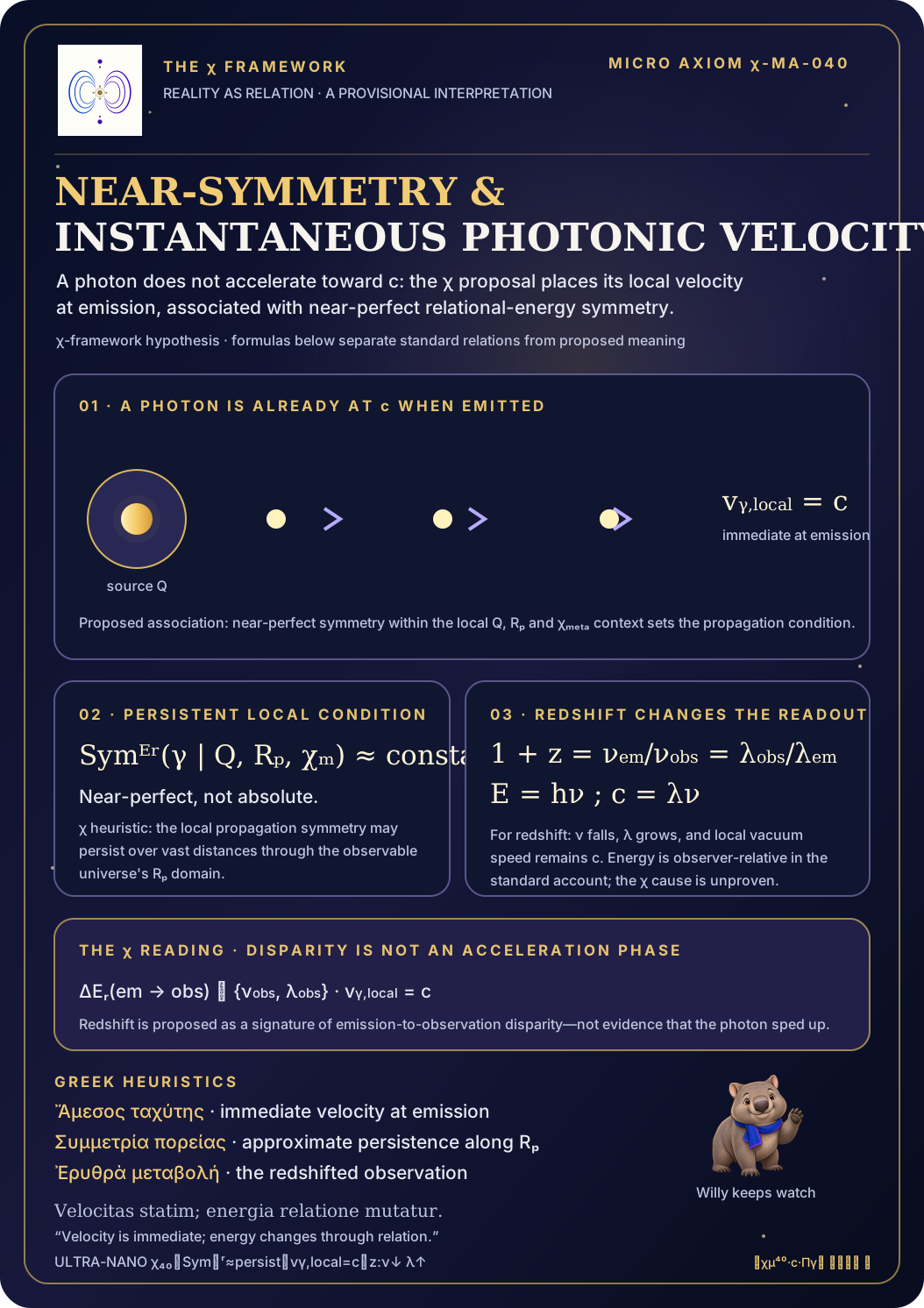
Established relations for comparison
For vacuum propagation, the locally measured photon speed is c. Redshift means the observed frequency is lower and wavelength is longer than at emission; these changes preserve c=λν. These standard relations do not establish the χ explanation.
χ-framework heuristic
The first line assigns the standard local value c an interpretive role in χ; it does not derive or modify c. The second is the proposal that local propagation symmetry persists approximately across the Rp region. The third treats redshift as a change in the emission-to-observation relational-energy comparison, reflected in measured frequency and wavelength—not as evidence of local acceleration or an altered propagation speed. All χ terms remain undefined, uncalibrated hypotheses.
Greek heuristics
Ἄμεσος ταχύτης — immediate velocity at emission. Συμμετρία πορείας — approximate persistence of the propagation condition across Rp. Ἐρυθρὰ μεταβολή — redshift as a measured change between emission and observation.
Velocitas statim; energia relatione mutatur. “Velocity is immediate; energy changes through relation.”
Ultra-nano: χ₄₀│Symᴱʳ(γ|Rₚ,χₘ)≈persist│vγ,local=c│z:ν↓ λ↑│ΔEᵣ em→obs
⟦χμ⁴⁰·c·Πγ⟧ · ☂︎⋈🥃 · ⌬
Open question: what operational relational-energy quantity would let this proposal predict a redshift while preserving the observed local value of c?
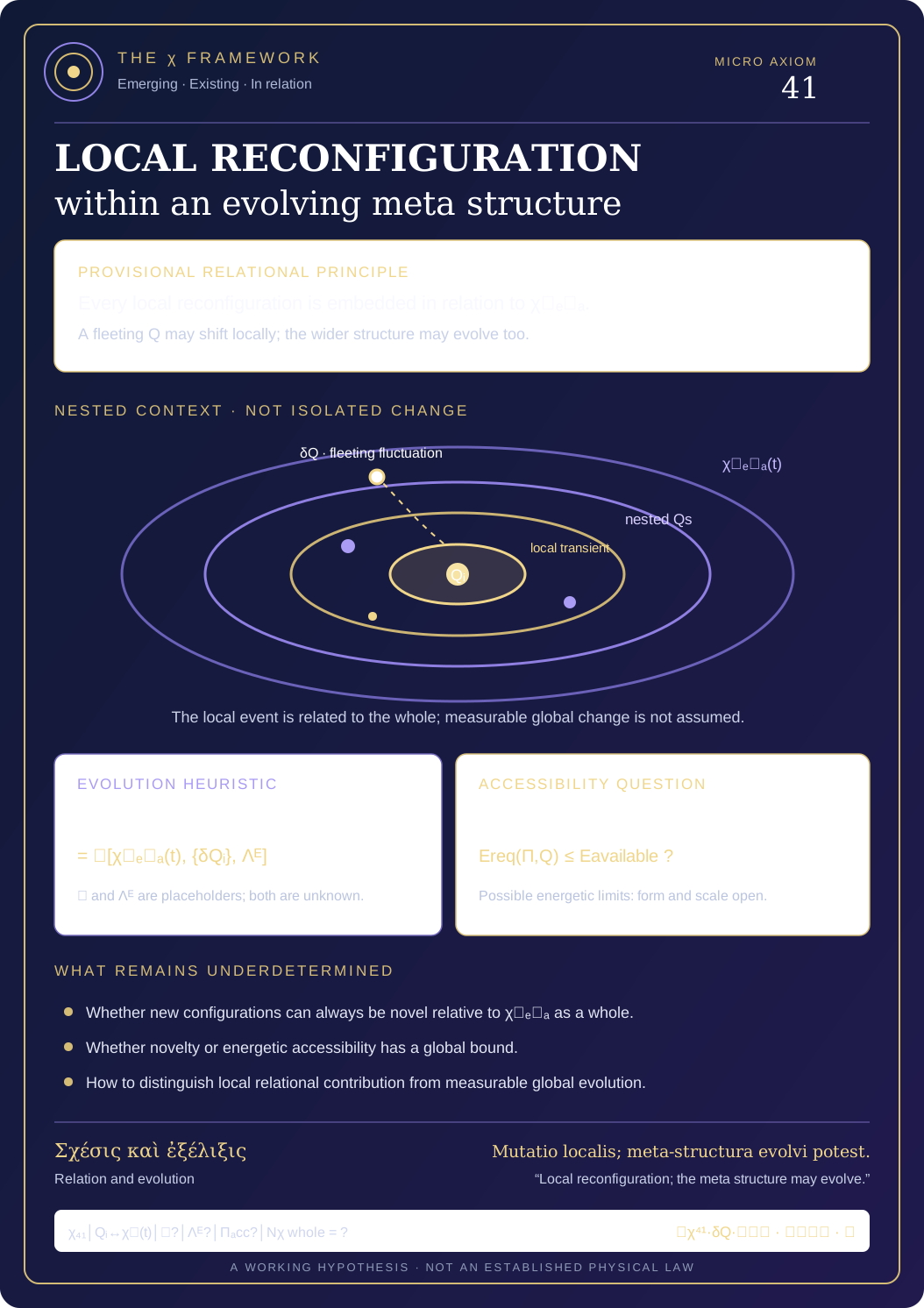
41 · Local Reconfiguration within an Evolving Meta Structure
Provisional relational principle. Every local reconfiguration is embedded in relation to the broader χmeta. A fleeting fluctuation may be treated as a transient quasi-equilibrium that changes a small system's configuration relative to the wider structure. The meta structure may itself evolve through these relations, while any energetic limits on accessible configurations remain unspecified.
Qᵢ is a local quasi-equilibrium, δQᵢ a local reconfiguration, ℰ a placeholder for possible meta-structural evolution, and ΛE a placeholder for possible energetic constraints. The relation marks embeddedness; it does not claim that every fluctuation produces a measurable global change.
Energetic accessibility, kept open
The inequality is a question-shaped heuristic: energetic conditions may limit which pathways become accessible, but neither the limit nor its form has been established. Whether relational-energy configurations can remain novel relative to χmeta as a whole, and whether novelty is bounded, is underdetermined.
Greek heuristic
Σχέσις καὶ ἐξέλιξις — relation and evolution. A local event belongs to its broader relational context; the structure of that context may change over time.
Mutatio localis; meta-structura evolvi potest. “Local reconfiguration; the meta structure may evolve.”
Ultra-nano: χ₄₁│Qᵢ↔χₘ(t)│ℰ?│Λᴱ?│Πₐcc?│Nχ whole = ?
⟦χ⁴¹·δQ·ℰₘ⟧ · ☂︎⋈🪅 · ✶
Open question: what would distinguish a local fluctuation’s relational contribution from a measurable evolution of χmeta as a whole?
41a · Energetic Accessibility within a Wider Meta-Structure
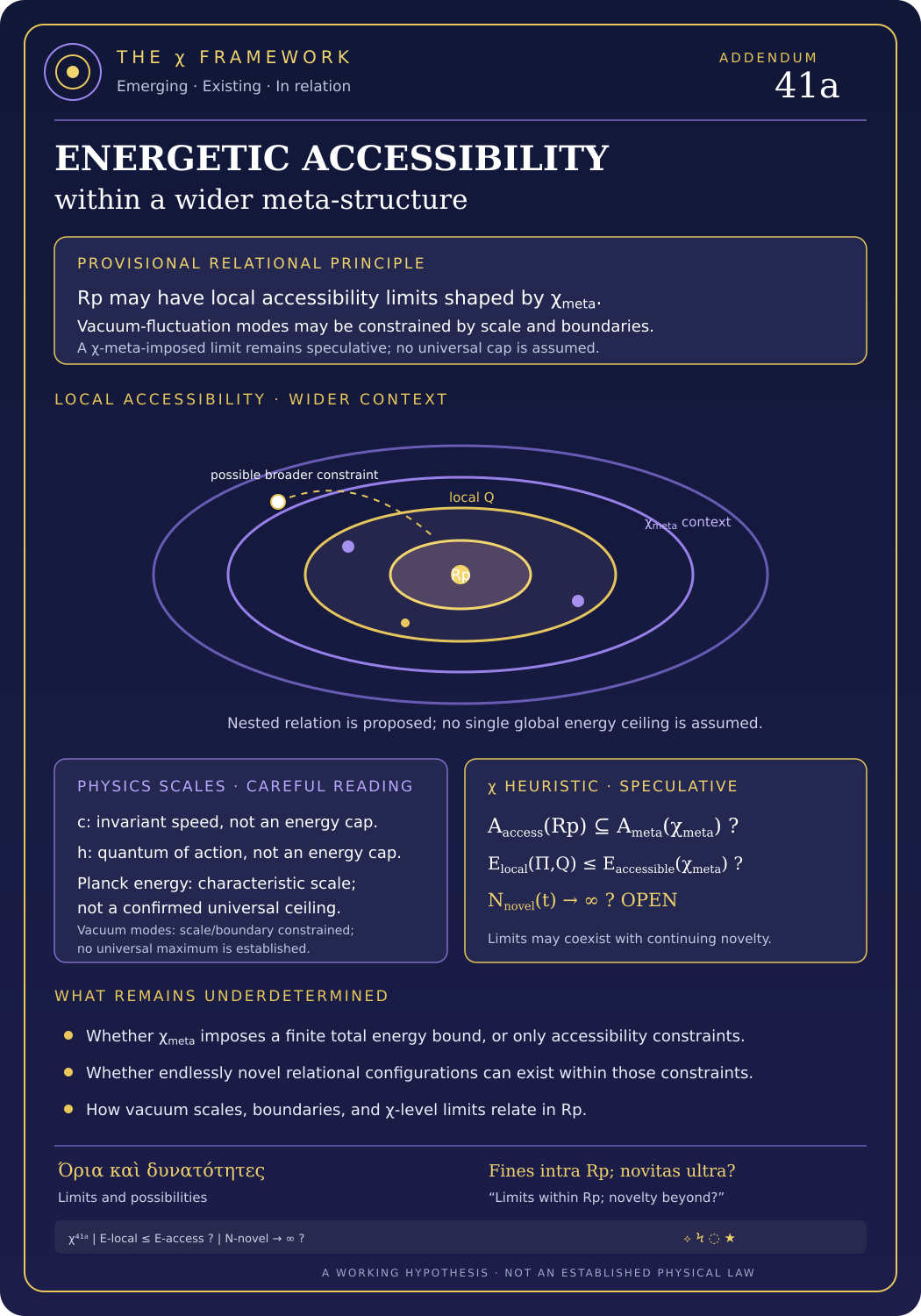
Addendum to Micro Axiom 41. The observable universe's Rp region may express local energetic-accessibility limits shaped by broader χmeta conditions. These could include constraints on which vacuum-fluctuation modes are available within a local field, scale and boundary context. The proposal that such conditions inherit a wider χ-meta limit is speculative.
Vacuum fluctuations and physical scales
In quantum field theory, the field modes and vacuum-energy calculations depend on the field, scale and boundary conditions; the Casimir effect is one example of boundary-dependent mode structure. This does not establish a single universal maximum for vacuum fluctuations. Likewise, c is an invariant speed and h a quantum of action; neither is itself an energy ceiling. Planck energy is a characteristic scale, not a confirmed universal cap.
Novelty within possible limits
Broader energetic constraints could coexist with continuing formation of novel relational-energy configurations inside those constraints. Whether novelty can be endless, whether χmeta has a finite total-energy bound, and how either idea could be tested remain underdetermined.
Ultra-nano: χ₄₁ₐ│Πacc(Rₚ)⊆Πpossible(χₘ)│vacuum modes: scale·boundary│Nnovel→∞?
⟦χ⁴¹ᵃ·Eₘ·Π∞?⟧ · ☂︎⋈◇ · ✦
Open question: what measurable vacuum-mode or field-scale signature could distinguish a local constraint from a proposed χ-meta accessibility limit?
41b · PES Inheritance and Observable Universe ↔ Rp
Revised frozen relational statement · χ-framework working hypothesis. Pre-existing relational-energy configurations within χmeta are proposed to make PES possible. In χ chronology, PES is a primordial relational-energy reconfiguration, analogous in chronological role to a Big Bang-type event: it forms Rp, observed as the observable universe. OUobs is the observationally accessible expression of Rp, carrying PES inheritance through later evolution and integration with χmeta.
Cpre denotes the proposed pre-existing relational configurations. PES reconfigures conditions within χmeta; it does not create the entire meta structure from nothing. The Big Bang comparison marks PES's role in the framework's chronology. PES is not identified here with the standard cosmological model or a confirmed physical event.
OUobs names the observer-accessible domain; Rp names the proposed reconfiguration domain and its evolving, partially preserved boundary condition. The shorthand OUobs ≈ Rp is frozen for discussion of the observed domain. Whether the two are strictly identical, and how an observational horizon maps to the Rp boundary, remain open.
Event, domain and observation
PES, Rp and OUobs name related stages or domains in the proposal: the event reconfigures antecedent conditions; Rp is the resulting, evolving domain; OUobs is its observable expression. Later structures and observed configurations also reflect continuing evolution, local quasi-equilibria and integration with χmeta. The shorthand OUobs ≈ Rp remains useful for discussing the observed domain, while strict identity and exact boundary mapping stay open.
Observational reach
In standard cosmology, light-based observations reach back to the cosmic microwave background, released when the universe became transparent. Earlier conditions are inferred from later evidence. This observational limit does not by itself establish where the proposed PES sits in the framework’s chronology. NASA overview of the early universe.
Ultra-nano: χ₄₁ᵦ│OUobs≈Rp(t)│PES→B_Rp│Δχ(Rp↔χmeta)≠0
⟦χ⁴¹ᵇ·OU↔Rp⟧ · ⟡Ϟ◌✦
Open question: what observation could distinguish the current OU horizon from the evolving Rp boundary?
Which assumption needs a clearer definition or a sharper test?
Bring it to the notice board